
You know that feeling, right?
You're trying to plan your marketing quarter, but the mountain of content you need to create is already making your head spin. Every entrepreneur and marketing manager knows this pressure cooker.
We're all told that consistency wins the online game, but actually *being* consistent?
That's a whole other beast. It leads us all to the same solution: automation. But here is the catch.
A quick search for an ai content generation tool returns millions of results, each promising to be the magic wand for your business.
It is overwhelming.
You might be wondering if you should go with the popular giant everyone talks about or the specialized tool that seems to understand your niche better. Making the wrong choice isn't just a waste of a monthly subscription fee.
It wastes your time, throws your workflow into chaos, and can sink your SEO if the output is garbage. Honestly, the stakes are way higher than people let on.

But when you finally land on the right ai content tool, one that clicks with your workflow, everything changes, and fast. Suddenly, you aren't just churning out words. You are building assets.
You are ranking for keywords.
You are driving traffic. At RobotSpeed, we see this transformation daily. Businesses that leverage our one-click automation for articles and backlinks stop struggling with writer's block and start focusing on growth.
But before you can get there, you need to filter through the noise.
This guide isn't just a list of software names. Think of this as your strategic game plan.
We've boiled the whole selection process down to a five-point checklist that forces you to focus on what really moves the needle: your ROI, the quality of the content, and your ability to scale.
So whether you're a health clinic that can't afford to get facts wrong or a real estate firm that needs to sell a lifestyle with every listing, this checklist will get you aligned with your actual goals.
1. Define Your Core Business Requirements and Use Cases
Before you get hypnotized by a fancy pricing page or a long feature list, you've got to look in the mirror. So, what does your business *really* need?
It sounds deceptively simple, but you’d be shocked how many teams jump right past this question. They get distracted by a shiny new feature like "text-to-video" when what their SEO *actually* needs is a steady stream of solid, long-form blog posts.
The truth is, different industries have wildly different needs. Just look at e-commerce, for instance.
If you're running a shop with thousands of products, your main challenge is churning out unique descriptions at scale without Google flagging you for duplicate content. A marketing agency, on the other hand, needs a tool that can be a chameleon, switching voices from client to client, going from casual and punchy one day to buttoned-up and corporate the next.
A generalist tool often fails here.
For those in the health sector, the game is different. Creativity takes a backseat to accuracy.
You cannot afford an AI that "hallucinates" medical advice.
Consulting firms need thought leadership that demonstrates deep authority. Real estate businesses need flowery, inviting descriptions for property listings.
The best ai content generation tool for you is the one that speaks your industry's language natively.
We recommend creating a "Must-Have" document. List your non-negotiables.
Do you need SEO metadata included?
Do you need bulk processing?
According to Clarity Ventures, aligning these features with your specific business goals is the first step to avoiding buyer's remorse later. You have to test these tools with your real-world briefs, not just some generic prompt.
See if it can actually follow your style guide or if it just ignores it.
2. Evaluate Quality Control and Accuracy Features
Alright, let's be real about AI for a second: It can be spectacularly, confidently wrong. We've all seen it, right?
An AI tool spits out a beautifully written paragraph about a historical event that never occurred or cites a convincing statistic it just made up. That's exactly why quality control features aren't just 'nice-to-haves.'
When you are vetting an ai content generation tool, look under the hood. Does it have built-in fact-checking?
Some advanced platforms now cross-reference their output with live search results to ensure data is current. This is critical for everything from news articles to technical guides.
You also need to think about unique checks. Does the platform include a plagiarism scanner? Even though AI generates new text, it can sometimes mimic existing content too closely.
A solid tool will flag this before you publish. Furthermore, look for readability analysis. It represents the difference between a wall of text key and engaging content that keeps users on the page.
Experts at Libril suggest that comprehensive quality checks, including AI detection and tone verification, must be part of your selection criteria.
For our clients at RobotSpeed, we know that content is only half the battle.
Quality also means authority. That is why we combine content generation with backlink automation.
High-quality content needs to be seen, and without the authority signals from backlinks, even the best writing can get lost. When checking for quality, ask yourself if the tool helps you rank, or just helps you write.
3. Assess Customization, Integration, and Scalability
Here is a scenario. You find a tool that writes great copy.
But to use it, you have to copy-paste every single paragraph into your WordPress editor, reformat the headers, add the images manually, and redo the meta tags. Suddenly, your "time-saving" tool is costing you hours in manual labor. Friction kills adoption.
Integration is often the deciding factor for scaling agencies. Can the ai content generation tool connect directly to your CMS? Does it integrate with your social media scheduler?
Tools that act as islands in your tech stack rarely last long.
You want a solution that flows into your existing river of work.
Scalability is the other side of this coin. Maybe you only need four articles this month.
But what happens when you want to ramp up to forty?
Or four hundred?
Check the usage limits and the processing speed. Some tools choke when you throw bulk requests at them.
Others, like RobotSpeed, are built specifically for high-volume output (think 30 articles a month on autopilot) without a drop in quality.
Customization goes beyond just putting your name in a field. Can you train the AI on your brand voice? Can you upload examples of your best-performing posts and tell the tool, "Write like this"?
AI Apps highlights that flexibility in tone, format, and keyword density is essential for businesses that want to maintain a unique brand identity while automating production.
4. Verify Security, Compliance, and Data Protection
It is easy to overlook security when you are chasing productivity hacks, but this is dangerous territory. Think about it: when you feed confidential client data, your team's proprietary research, or sensitive customer info into a public AI model, where is that data actually going?
Is the platform using your prompts to train its public model?
For anyone in finance, law, or healthcare, this isn't just a concern, it's a legal minefield.
HIPAA and GDPR compliance aren't just buzzwords to throw around; they're hard requirements.
You absolutely have to check that the AI tool you're considering has solid encryption and crystal-clear data policies. You should know exactly who owns the content you generate.
Look for enterprise-grade security features. Does the tool offer Single Sign-On (SSO)? Is there a clear service level agreement (SLA) regarding uptime and support?
When your content pipeline depends on software, you need to know there is a human support team available if things break. Data privacy transparency is a major indicator of a reputable vendor.
5. Test Performance in Real-World Conditions
Buying software without a pilot run is like buying a car without a test drive. You look at the specs, but you don't know how it feels on the road.
Before you commit to an annual contract, run a stress test.
And we don't mean just generating one funny poem.
Get your team involved. Have your writers, editors, and SEO specialists use the tool for a week.
Measure the results objectively.
How much editing time was required?
Did the "one-click" article actually require an hour of fact-checking?
Did the keywords integrate naturally, or did they feel stuffed?

For e-commerce specifically, test if the descriptions actually convert.
Run an A/B test with AI copy versus your old copy. For real estate, see if the listings generate more inquiries.
The team at Two Brothers Creative emphasizes the importance of validating the output against actual business metrics. If the tool saves time but kills your conversion rate, it is not an asset; it is a liability.
Comparing the Top AI Content Tools
The market is crowded, and different tools excel in different areas. We've broken these down to show you which tool is built to solve which specific problem.
1. RobotSpeed: Best for Automated SEO & Backlinks
If your main goal is to rank on Google without hiring a huge content team, then RobotSpeed is designed specifically for you. Here's the key difference: while other tools are built to help you *write*, RobotSpeed is built to help you *rank*. We automate the creation of 30 high-quality articles for you every month and, this is the crucial part, we give you 100 backlink credits daily.
No other tool combines content generation with off-page SEO automation in this way.
2. Narrato: Best for Workflow Management
Narrato is fantastic for marketing agencies that need to manage a content calendar. It offers strong collaboration features and SEO briefs.
It is less of a "magic button" and more of a workspace for content teams.
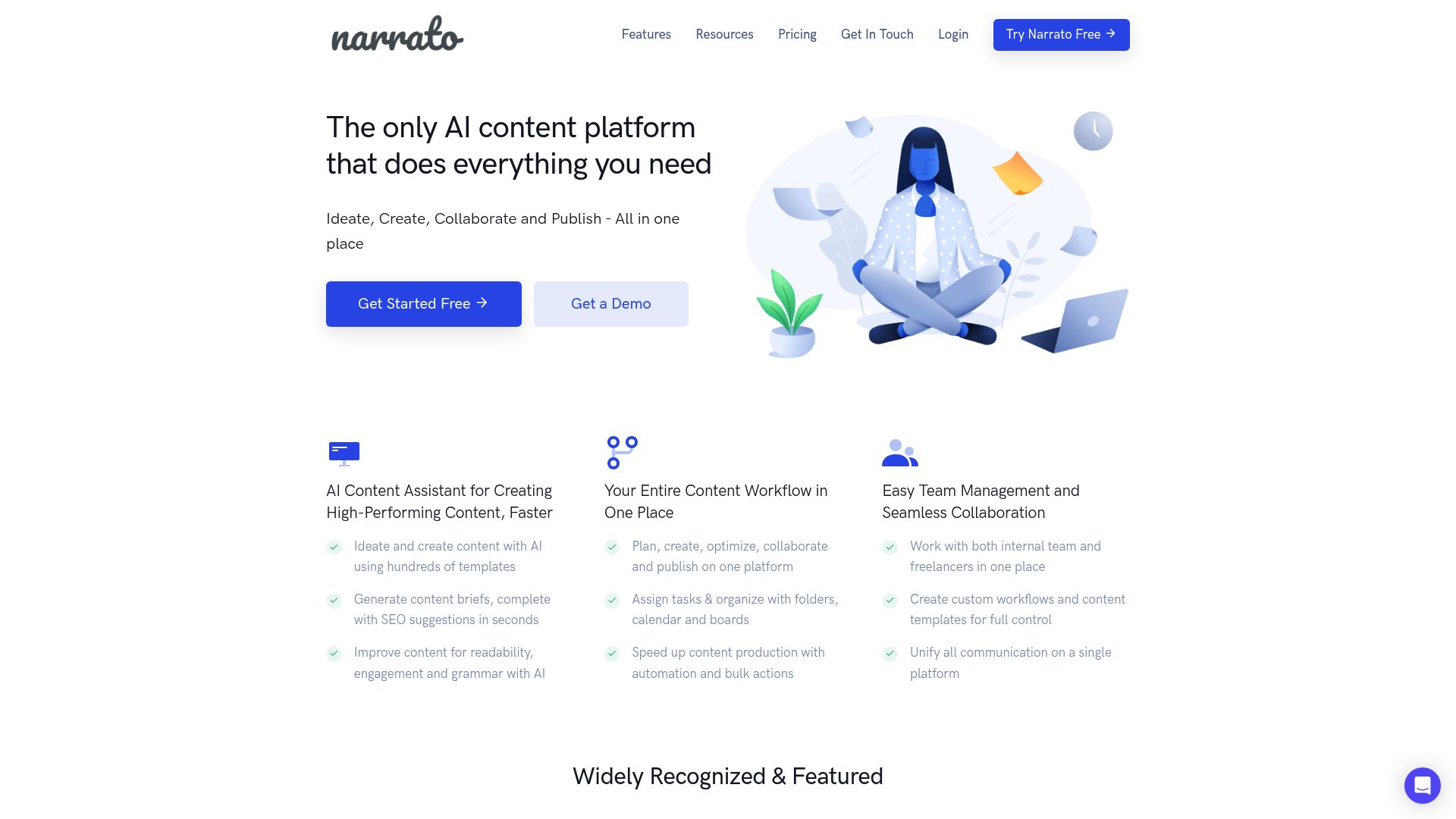
Above is a peek into the Narrato workspace interface. Source: https://narrato.io
3. Jasper: Best for Multi-Format Creativity
Jasper has really carved out a niche for itself by being a jack-of-all-trades. If you need to whip up marketing emails, video scripts, and Facebook ads all from one dashboard, it's definitely a strong contender.
4. MarketMuse: Best for Deep Content Optimization
Its "Brand Voice" feature is pretty good for customization. Now, onto MarketMuse, which is all about deep data. It digs through the SERPs to show you precisely what topics and keywords your competition is ranking for that you aren't.
It is expensive and has a steep learning curve, but for deep technical SEO audits, it is powerful.
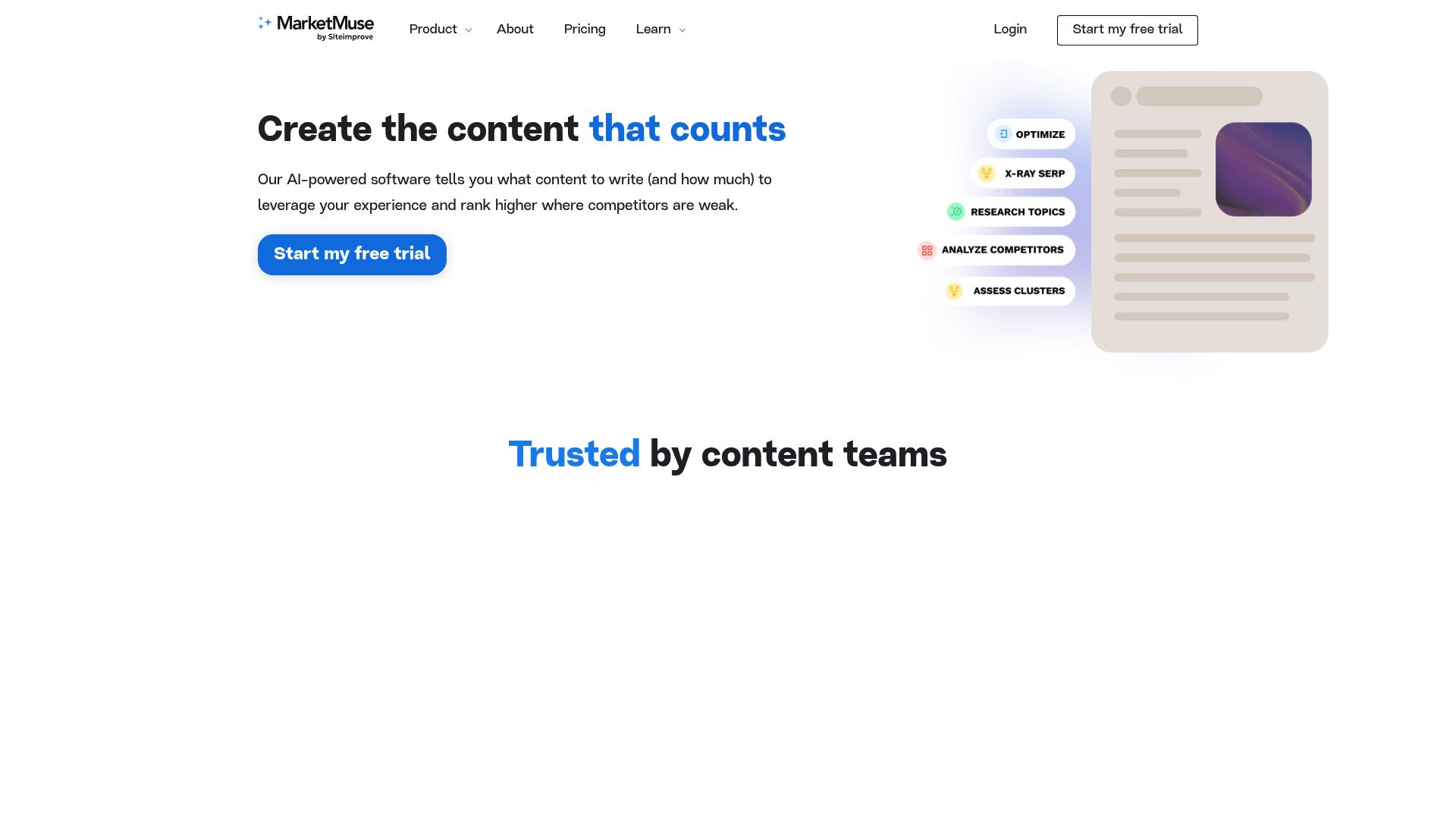
Above: MarketMuse content analysis dashboard.
Source: https://www.marketmuse.com
How RobotSpeed Simplifies the Selection
We built RobotSpeed because we saw a gap in the market. Most Entrepreneurs and agencies were cobbling together three or four different subscriptions: one for writing, one for keyword research, and another agency just for backlinks.
It was messy and expensive.
By choosing an inclusive platform, you eliminate the integration headaches we mentioned in point three.
You don't need to worry about the "quality control" of your backlink profile because we handle that automation for you. We focus on the metric that actually keeps business owners awake at night: traffic growth.
Of course, this relates back to the checklist.
And hey, put us to the test. Check our output flexibility. See what our platform actually does to your rankings.
We're confident that for any business obsessed with growth and real SEO results, the numbers will speak for themselves.
Conclusion
Choosing the right AI content tool isn't just another software decision, it's a pivotal moment for your entire digital strategy. It can be the one thing that separates a stagnant blog from a true traffic-generating machine.
Just remember to stay focused on what you actually need it for, double-check its accuracy, make sure it plays nicely with your other tools, and never, ever compromise on security.
Don't get distracted by the shiny features that you will never use. Focus on the tools that move the needle for your business objectives. If your objective is comprehensive SEO dominance through effortless content and authority-building backlinks, we invite you to explore what we have built.
Ready to stop writing and start ranking?
Check out RobotSpeed today and see how full automation can change your business trajectory.
FAQ: Picking Your AI Content Platform
Q: Can these AI tools completely replace my human copywriters?
A: Not really. Think of AI as a super-powered assistant, not a replacement.
It does the heavy lifting, the initial drafting and research, so your human writers can focus on the stuff that matters most: strategy, making an emotional connection, and adding that final creative polish.
Q: Is Google going to penalize me for using AI content?
A: Here's the deal: Google has been very clear that they reward high-quality, helpful content, no matter how it was made.
The key is value. If your tool creates helpful, accurate content, you are safe. Spammy, low-quality content is penalized, whether written by a human or a robot.
Q: How important are backlinks when using AI content?
A: Extremely important. AI has made content easier to produce, meaning there is more competition.
Backlinks are the trust signal that tells Google your content is authoritative. This is why RobotSpeed bundles backlinks with content generation.
Q: What's the most cost-effective AI tool out there?
A: That's a great question, and the answer really comes down to ROI, not just the sticker price.
A cheap tool that forces you to spend hours editing isn't cheap at all.
When you look at the cost-per-result, a comprehensive platform like RobotSpeed that automates the whole SEO workflow, from content creation to backlinks, often ends up being far more cost-effective.