
You know that feeling when you are searching for something online but you aren't quite ready to buy?
That moment represents a massive opportunity for businesses. We often get caught up trying to rank for "best sneaker store" or "cheap SEO consultant" because those terms scream money.
But if you only focus on those queries, you're leaving a huge chunk of potential traffic on the table. If you want to really own your niche, you've got to get good at creating AI content for informational keywords.
The stats here are pretty eye-opening. Did you know that a whopping 80% of all search traffic comes from informational keywords?
That's a massive number. We're talking about people in the "awareness" stage of the buying journey, searching for things like "how to," "what is," or "guide." They are not reaching for their wallets yet, but they are looking for an expert to trust.
If you can be that expert, you win their loyalty before they ever look at a price tag.
This is where artificial intelligence changes the game.
Creating depth at scale used to be impossible for small teams. This is where platforms like RobotSpeed come in, letting entrepreneurs, marketing agencies, and even real estate businesses quickly pump out high-quality, authoritative articles that hit these specific questions. By using AI content for informational keywords, you attract top-of-funnel traffic that eventually trickles down to your product pages.
Think of it this way. If you run a health sector business, a user might search "how to lower stress naturally" long before they search for "buy cortisol supplements." By providing the answer to the first question, you position your brand as the solution provider.
In this tutorial to creating high-value content, we are going to break down exactly how to execute this strategy without sounding like a robot.

Understanding Informational Keywords and Audience Intent
Before you start generating text, you need to understand the psychology behind the search. Informational keywords are the digital equivalent of window shopping or asking a store clerk for advice.
The user has a problem, but they might not even know the name of the solution yet. According to industry research, targeting these keywords allows you to introduce your brand before competitors even show up on the radar source.
For the diverse industries we serve, such as consulting firms or e-commerce businesses, the intent usually falls into a few buckets.
You have the "Quick Answer" seekers who want a definition. Then you have the "Deep Dive" researchers who want a comprehensive guide.
AI content for informational keywords must cater to both. If you only provide surface-level answers, Google will likely pass you over for a competitor who went deeper.
You also have to look at the specific language used. Users leverage words like "tutorial," "tips," "examples," and "strategies." These are non-transactional modifiers.
If you try to sell too hard in these articles, you will scare the reader away. The goal is trust, not a transaction.
Not yet, anyway.
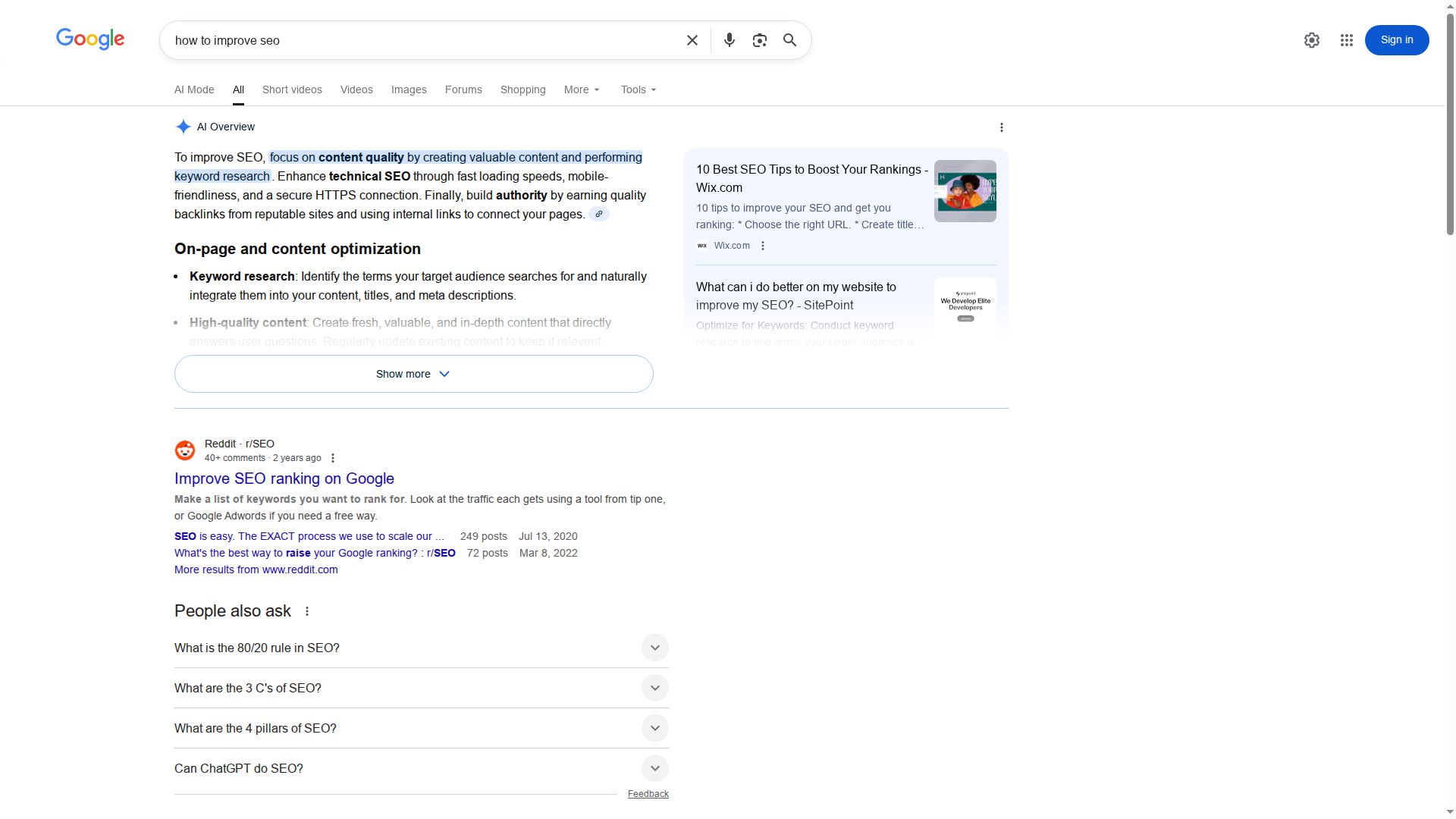
Google gives us massive clues about this intent. Look at the Search Engine Results Page (SERP).
Do you see a "People Also Ask" box?
Do you see a Featured Snippet?
Do you see video results?
These are all signs that Google categorizes the query as informational.
Your content needs to match that format. If Google shows a listicle, you write a listicle.
If they show a video, you embed a video or write a step-by-step script.
Strategic Keyword Research Using AI
The old way of doing keyword research involved hours of staring at spreadsheets.
Today, we can leverage intelligence to speed this up dramatically.
The foundation of effective informational content begins with understanding your audience's pain points. You can't just guess what they want.
Start by consulting your internal data. Talk to your sales teams or customer service representatives. What questions do they hear every single day?
Those questions are gold mines for content. Once you have those core ideas, you can use AI to expand them into a massive list of opportunities.
Here is a practical workflow. You take a "seed keyword", let's say "home automation" if you are in real estate or tech.
You can ask an AI tool to "Give me 10 semantically relevant, but unique topics under the main category of home automation." Suddenly, you have specific titles like "Best smart locks for rental properties" or "How to automate lighting for energy efficiency." These are specific, high-value topics source.
AI excels at finding long-tail keywords. These are longer, more specific phrases that have lower competition but higher intent.
Instead of fighting for "SEO," you fight for "how to create AI content for informational keywords for small business." The volume is lower, but the people searching for it are exactly who you want to talk to.
It is also crucial to analyze the search intent behind these AI-generated suggestions. Some tools might give you a mix of commercial and informational terms.
You need to filter them.
Look for the "how," "what," and "why." In 2025, with the rise of conversational search, natural speech patterns are winning. People speak to potential voice assistants like they speak to friends.
Your keywords need to reflect that natural language.
Creating Content Clusters with AI Tools
One standalone article rarely moves the needle.
To establish true authority, you need to think in clusters.
This is often called the "Hub and Spoke" model.
You have one massive "Pillar Page" that covers a broad topic generally, and then you link out to 10 or 20 specific articles that go deep into sub-topics. Creating content clusters with AI makes this process incredibly efficient.
Let's look at an example for a consulting firm. Your pillar topic might be "Business Process Optimization." So, your cluster content, which tools like RobotSpeed can help you generate, might cover topics like "How to map a workflow," "Cutting back on supply chain redundancy," or even "Employee onboarding checklists." Every one of those articles links back to your main pillar page, and the pillar links out to them.
This setup is what signals to Google that you're an authority on the whole topic, not just a single keyword.
What's cool is that AI clustering tools can automatically sort your keyword lists by how they relate to each other. This prevents "keyword cannibalization," which happens when you have two articles fighting for the exact same spot in Google source.
When you organize your content this way, you also keep users on your site longer. They confuse reading about one sub-topic and naturally click to the next. This signals to search engines that your website provides high value, which in turn boosts your rankings for the main AI content for informational keywords you are targeting.

Developing Comprehensive, High-Quality Content
Now we get to the actual writing. There is a misconception that AI content is "thin" or "spammy." That is only true if you use it lazily. If you want to rank in 2025, your content has to be the single best, most complete answer on the internet for that question.
Period. Google loves depth.
It wants to see that you’ve looked at the topic from every possible angle.
When you're using RobotSpeed for your monthly articles, you need to make sure the final piece really goes deep and covers everything. Structure is a huge deal.
You need one, and only one, H1 tag with your main keyword. Then, you'll want to sprinkle related keywords naturally into your H2 and H3 tags. This isn’t just for the search engine bots; it actually helps real people scan your content, too.
Research consistently shows that longer content tends to rank higher for informational queries.
We aren't talking about fluff. We leave the fluff out. We are talking about adding examples, data points, and actionable steps.
If you reach less than 200 words in a section, ask yourself: "What else does the user need to know?" Add a case study.
Add a comparison table. Add a checklist.
For AI content for informational keywords, natural keyword placement is vital. In the past, people would stuff keywords everywhere.
That looks terrible. Today, you want to keep your density around 1-2%. The keyword should appear in the title, the first paragraph, and a few subheaders.
Beyond that, use synonyms and semantic variations. Let the AI suggest where these terms fit naturally so the reading flow isn't interrupted.
Boosting Organic Traffic with AI Optimization
Writing the content is half the battle. Optimization is the other half.
This is where boosting organic traffic with AI really shines.
You need to ensure that your metadata, the title tag and meta description that show up in search results, is irresistible. This is your billboard on the highway of Google.
Your meta description should be between 150 and 160 characters. It needs to include your primary keyword, but it also needs a hook. Ask a question or promise a solution.
For example: "struggling to rank?
Learn how to create AI content for informational keywords that drives real traffic and builds authority in our step-by-step guide."
You also need to think about internal linking. We touched on this with clusters, but it bears repeating.
Every time you post a new article, go back to your old articles and link to the new one where relevant. This spreads "link juice" throughout your site.
While RobotSpeed gives you 100 backlink credits daily to build external authority, it’s your internal linking that keeps all that power flowing through your site the right way.
Another powerful way AI can boost your organic traffic is by helping you refresh old content. Look, information gets stale fast.
A guide written in 2022 could be totally useless today. You can actually use AI to go through your old posts, flag any outdated stats or trends, and suggest fresh updates. Keeping that "publish date" recent is a powerful signal to Google that your site isn't just sitting there collecting dust.

Industry-Specific Strategies for Informational Content
Different industries require different flavors of informational content.
What works for a doctor won't work for a sneaker shop. Here is how you can tailor your AI content for informational keywords based on your sector.
Health Sector Businesses
Trust is everything here. Your content should really dig into conditions, treatments, and wellness practices. You're not just writing articles; you're offering up genuine health solutions.
Use AI to pull in the latest research, but always, and I mean always, have a human review it for accuracy. Think about topics like "What are the early signs of burnout?" or "How does preventative care actually save money?" build incredible trust.
Real Estate Businesses
For real estate businesses, remember: you're selling a lifestyle, not just four walls and a roof. Build content around locations. "Living in [City Name]: A complete guide for families" or "The process of buying your first commercial property." These guides attract people months before they call an agent.
You become their tour guide first, and their realtor second.
E-commerce Businesses
Don't just describe the product. Solve the problem the product fixes.
If you sell coffee machines, write "How to brew coffee like a barista at home" or "Why is my coffee bitter?" These articles capture the coffee enthusiast who eventually realizes they need your high-end machine to get the result they want.
Marketing Agencies and Entrepreneurs
B2B buyers love data and frameworks.
Produce strategy guides, tool comparisons, and trend analyses. "How to implement AI in your workflow" or "Comparing the top 5 CRM tools for startups." This demonstrates that you understand the complex landscape they operate in.
The Human Touch in AI Content Creation
We have talked a lot about automation, but let's be real for a second.
People connect with people.
While RobotSpeed gives you the power to generate 30 articles a month, your unique brand voice is the secret sauce.
You cannot just copy-paste and walk away. You need to inject personality.
When reviewing your AI content for informational keywords, look for the "robot voice." You know the one. It uses perfect, boring transitions like "In conclusion" or "Moreover." Cut those out. Replace them with conversational phrases like "Here's the thing," or "You might be wondering." Use contractions.
Say "don't" instead of "do not." It sounds more like a friend explaining a concept over coffee.
Add personal anecdotes or specific industry insights that an AI might miss. "We noticed last year that our clients struggled with X..." adds a layer of authenticity that is impossible to fake.
This hybrid approach, AI for the heavy lifting and structure, humans for the flavor and empathy, is the winning formula for 2025 and beyond.
Performance Tracking and Continuous Improvement
You can't improve what you don't measure. Once your content is live, you need to watch it like a hawk. Which articles are bringing in traffic?
Which ones have a high bounce rate?
High bounce rates on informational content might mean you didn't answer the question quickly enough.
Use tools to track your rankings for the specific informational keywords you targeted. If you see a piece of content sitting on page 2 of Google, that is a prime candidate for optimization. Go back in, add more depth, add a video, or improve the headers.
Sometimes a small tweak can bump you to page 1.
Remember, SEO is a marathon, not a sprint. But with tools like RobotSpeed, you are running that marathon with a jetpack.
By consistently publishing high-quality, optimized content, you build a moat around your business that competitors will finding very hard to cross.
Conclusion
Creating high-value AI content for informational keywords is no longer optional; it is the cornerstone of modern digital marketing. It allows you to meet your customers right where they are, search for answers, looking for guidance, and waiting for a leader to show them the way.
By understanding search intent, leveraging AI for research and clustering, and maintaining a commitment to comprehensive quality, you can dominate your niche.
The beautiful thing is that you don't have to do it manually.
Automation allows you to scale your expertise without burning out your team.
If you are ready to stop chasing traffic and start attracting it with authority, it is time to upgrade your workflow. Explore how RobotSpeed can help you generate 30 SEO-optimized articles a month and automate your backlink strategy today.
FAQ
What are informational keywords?
Informational keywords are search queries where users are looking for answers, guides, or knowledge rather than looking to buy a specific product immediately. These searches usually start with 'how,' 'what,' or 'why.'
How does AI help with informational content?
AI is a game-changer here: it can spot high-potential keywords, build out solid outlines, crank out drafts in no time, and make sure everything is semantically related. This all helps you rank higher and cover topics way more thoroughly than you could by hand.
Why is creating content clusters important?
So, why bother creating content clusters?
Using AI to create these clusters is the best way to sort your website into logical topic sections. Doing this builds what we call 'topical authority' with search engines, proving you’re an expert on the whole subject, not just one keyword.
How often should I post informational content?
Honestly, consistency is everything.
Publishing on a regular schedule sends a strong signal to Google that your site is alive and well.
That's where services like RobotSpeed come in, letting you keep up a high frequency, like 30 articles a month, so you can grow your traffic much faster.