
The digital world is buzzing with a new question that feels both futuristic and incredibly present.Is this content written by a human or a machine?
We've arrived at a point where artificial intelligence can draft articles, write emails, and generate marketing copy in seconds, creating a tidal wave of new content. This boom in productivity, however, brings an equally significant challenge for entrepreneurs, marketing agencies, and businesses across every sector from e-commerce to real estate. But how are you supposed to keep your content authentic and high-quality when the line between human and AI is getting so blurry?
That right there is why figuring out AI detection methods has become way more than an interesting thought experiment, it's a flat-out critical business skill. You really have to be able to effectively ai detect machine-generated text if you want to safeguard your brand’s reputation, keep your SEO efforts from getting penalized, and hang on to the trust you've built with your audience. Think of it as the new frontier of quality control in the digital age.At its heart, the technology designed to ai detect content isn’t magic. It operates on a sophisticated analysis of language patterns.As detailed in research from sources like Bluehost and Zapier, these tools are trained on vast datasets of human writing.They learn what natural, human-driven text looks like, with all its quirks, complexities, and occasional imperfections. When they analyze a piece of content, they are essentially looking for the opposite, the tell-tale signs of a machine. These can include overly predictable word choices, repetitive sentence structures, and a strange lack of contextual nuance that a human writer would naturally include.In essence, AI-generated content can sometimes feel a little too perfect, a little too uniform, and that's the very thing these detectors are designed to flag.This guide will walk you through the essential methods and tools you need to navigate this new landscape effectively.
Understanding The Mechanics of AI Detection
To effectively use AI detection, it helps to know what's happening under the hood. AI content detectors primarily function by measuring how predictable a piece of text is. Imagine reading a sentence and being able to guess the next word with near-certainty.According to insights from Bluehost's analysis, AI models are trained to do just that, selecting the most statistically probable word to follow the last.This creates text that is coherent but often lacks the surprising turns of phrase or creative leaps characteristic of human writing. That statistical predictability, the stuff experts call "perplexity" and "burstiness", is exactly what the detectors are designed to lock onto. Low perplexity means the text is straightforward and predictable, a strong indicator of AI generation.You can think of it like this. A human writer might use an unexpected metaphor or a colloquialism that an AI wouldn't risk. These tools are built to spot an unusual consistency that feels unnatural.They scrutinize content for repetitive sentence openers, a limited vocabulary, and a flawless, almost sterile, grammatical structure. Honestly, it’s turned into this fascinating cat-and-mouse game: generative AI gets scarily good at mimicking human writing, and the detection tech has to get even more sophisticated to keep up. The good news is that studies from places like SearchLogistics show the detection side is advancing super fast, and is often a step ahead of the content generators. And seriously, if you're interested in understanding AI-generated text on a deeper level, the way this stuff works under the hood is actually pretty fascinating.

This constant evolution means that what might have passed a detector six months ago is likely to get flagged today. The models are continuously updated to recognize the signatures of new generative tools like GPT-4o and Claude. This is great news for content managers and anyone concerned with authenticity.It means that relying on raw, unedited AI output is becoming an increasingly risky strategy for anyone serious about their content. The goal isn't just to pass a check but to produce genuinely valuable material that connects with a human reader.
Leading AI Detection Methods and Tools for 2025
Navigating the world of AI detection means getting familiar with the specific methods and the tools that employ them. It's not a one-size-fits-all situation. The most common approach involves Natural Language Processing (NLP) models.These are machine learning systems trained to analyze text for those statistical giveaways we talked about, such as sentence variety and word choice. Tools like GPTZero and Sapling are front-runners in this space, offering detailed analysis that can even highlight specific sentences that are likely machine-generated, as reported by Zapier.Another powerful method combines AI detection with a traditional plagiarism check. This is particularly useful for publishers and academic institutions. Platforms like Originality AI and Copyleaks have built their reputation on this dual-functionality.They don't just tell you if the content was written by an AI, they also check plagiarism against a vast index of web pages and academic papers. This provides a comprehensive C a for content integrity. For those looking for a comprehensive overview of the market, this list of AI content detection tools offers a great starting point for comparison.
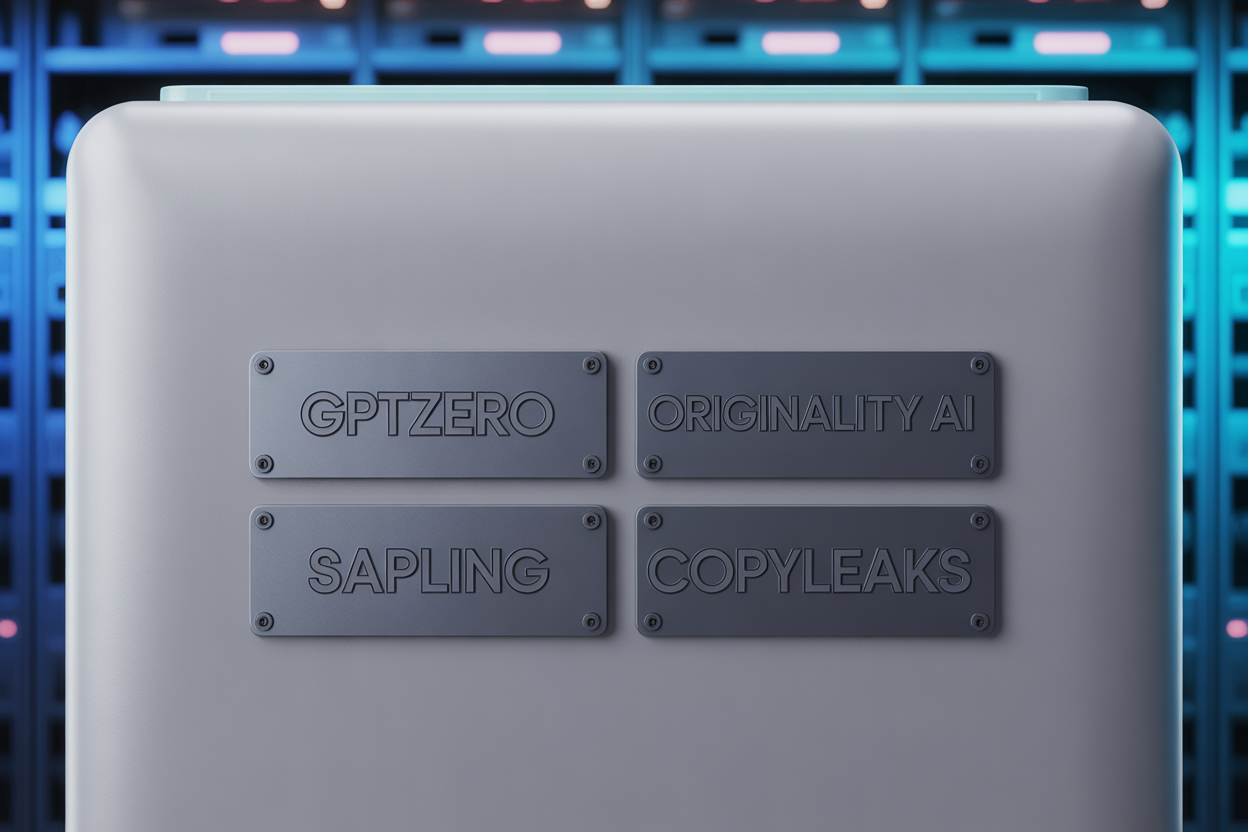
Here’s a quick rundown of some of the leading tools you should know about, based on extensive reviews from sources like Retable.io:
- Sapling AI: Praised for its high accuracy and ability to stay updated with new AI models. It provides sentence-level analysis, which is great for pinpointing specific areas for revision.
- GPTZero: A favorite in the education sector, it offers detailed writing analytics that go beyond a simple AI or human score, giving deeper insights into the text's structure.
- Originality AI: The tool of choice for many content marketers and publishers because it bundles a top-tier ai detection feature with a robust plagiarism checker and readability scores.
- Copyleaks: Known for its broad integrations and multilingual capabilities, making it a strong choice for global organizations and educational institutions.
Each tool has its strengths, and the best choice often depends on your specific needs, whether that's bulk processing for an agency or detailed analysis for a single high-stakes document.
Are AI Detectors Foolproof
Here's the million-dollar question. So, can you actually trust the results of an AI detector?
Let's be real: no, not 100% of the time. Don't get me wrong, modern tools have gotten incredibly accurate, and some studies show they're almost perfect at sniffing out raw AI text, but no system is ever foolproof. The biggest challenge you'll run into is something called a "false positive," which is when a tool flags perfectly good human writing as if it came from an AI.This can happen with text that is very formulaic or technical, as noted in reports from Bluehost.Conversely, highly edited and paraphrased AI content can sometimes evade detection, slipping through the cracks.Because of this, a critical best practice has emerged, one that is heavily endorsed by experts. You should never rely on a single tool. As a case study by SearchLogistics recommends, cross-referencing your content across two or three different detectors is the most reliable strategy. Each tool uses a slightly different algorithm and dataset, so if they all reach a consensus, you can be much more confident in the result.One tool might be overly sensitive to repetitive language, while another is better at spotting unnatural flow. Using them in combination helps mitigate the individual weaknesses of each platform and gives you a much more balanced and accurate assessment. This multi-tool approach is becoming standard practice for anyone serious about AI-generated content detection.Ultimately, these tools are best used as a guide, not a judge. They provide data and probabilities, but the final call should always involve human oversight. If a tool flags a piece of content, it's an invitation to look closer.Examine the highlighted passages, assess the tone, and use your own judgment. Is the writing genuinely uninspired, or is it just a clear, concise piece of technical writing that the algorithm misunderstood?
This combination of advanced technology and human expertise is the most powerful way to ensure content authenticity.
Putting AI Detection to Work in Your Industry
The applications of AI detection are not just theoretical, they are incredibly practical and vary across different professional fields. For educators, these tools have become indispensable. They provide a straightforward way to uphold academic integrity by scanning student submissions for potential AI authorship, ensuring that the work reflects the student's own learning and effort.This is a critical issue in modern pedagogy, and as discussions around AI in education highlight, detection tools are a key part of the solution.For marketing agencies and content managers, the stakes are different but just as high. Your primary goal is to create content that ranks on search engines and resonates with an audience. Search engines like Google have been clear that they prioritize high-quality, helpful content created for people.Over-reliance on low-effort, obvious AI content could risk SEO penalties. More importantly, it can damage audience trust. An effective ai detect workflow allows you to vet content from freelancers, junior team members, or even your own AI-assisted drafts to ensure they meet your brand's standard for quality and authenticity.

This principle extends to virtually every business. An e-commerce business needs product descriptions that persuade and connect, not just list features robotically. A consulting firm must produce reports and proposals that radiate human expertise and authority.Even in real estate, property listings written with a human touch can create a more compelling emotional connection with potential buyers. By integrating an AI detection step into your content creation process, you are actively choosing to protect your brand's voice and ensure that your communication, whether with clients, customers, or prospects, remains genuinely human.
Embracing a Smarter Content Future
As we've seen, the world of AI content creation and detection is complex, dynamic, and incredibly important. It's no longer enough to simply produce content. We must produce it responsibly.Understanding the core methods of how an ai detect tool works, from analyzing predictability to spotting repetitive structures, empowers you to be a more discerning content creator and manager. Knowing the landscape of leading tools like Sapling, GPTZero, and Originality AI gives you the practical ability to implement a robust quality control process.The key takeaway is clear, you should leverage these powerful technologies but never surrender your own critical judgment.The smartest approach is a balanced one. A multi-tool strategy is essential to avoid the pitfalls of false positives and build confidence in your results. Combining the insights from several AI detectors gives you a more complete picture, transforming a simple check into a comprehensive audit of authenticity.This isn't about demonizing AI, it's about using it wisely. Artificial intelligence is an unbelievable accelerator for brainstorming, outlining, and drafting, but the finishing touches, the nuance, and the final seal of quality must remain human. It's this beautiful synergy between machine efficiency and human creativity that will define the most successful content strategies moving forward.At RobotSpeed, we are built on this very principle. Our platform is designed to handle the heavy lifting of SEO content creation and backlink automation, generating a high volume of optimized articles to fuel your growth. But we understand that success in SEO is about more than just quantity.It's about quality that connects with readers and is recognized by search engines. By handling the automation, we free you up to focus on strategy and adding that crucial human element to your content. If you're ready to scale your content marketing without compromising on quality, we invite you to explore the RobotSpeed platform.See how one-click automation can revolutionize your SEO results and help you win in a competitive digital world.