
The game has changed entirely. You used to be able to look at a keyword ranking report, see your position in the top three, and know exactly how much traffic to expect. That world is gone.
Today, we face a landscape dominated by AI Overviews, rapid answer engines like Perplexity, and a fundamental shift in how search engines value information.
If you navigate this new terrain using old maps, you are going to get lost.
Business owners and marketing directors often ask us what actually matters now.
Traffic feels volatile. Click-through rates on traditional blue links are dropping. Yet, some companies are growing faster than ever.
The difference lies in what they measure. Understanding the most important SEO metrics for AI content is the only way to ensure your digital strategy isn't just shouting into the void.
When we built RobotSpeed to help businesses automate their SEO, we realized that producing content 40x faster wasn't enough if you couldn't measure its impact in an AI-first world. You need to know if the algorithms trust you. You need to know if you are the entity they cite when a user asks a complex question.
It’s no longer just about keywords; it’s about authority, freshness, and engagement.
Look, the panic is unnecessary. Yes, zero-click searches are rising, but the value of the clicks that do happen is increasing. Users who click through from an AI Overview are often pre-qualified.
They have read the summary, they have context, and now they want the deep dive.
Your job is to make sure your content is the one providing that deep dive.
In this guide, we are going to tear down the vanity metrics of the past and build a new dashboard for 2025. We will look at exactly how to track visibility in a world without traditional rankings, how to measure the trust machines engage with your brand, and ultimately, how to tie it all back to revenue.

1. AI Visibility and Citations Across Platforms
Let's be honest about where search is heading. It is not just Google anymore.
You have users asking ChatGPT for software recommendations, using Perplexity to research market trends, and relying on Bing's Copilot for quick answers. The first and perhaps the entry point of the most important SEO metrics for AI content is your citation frequency.
When a large language model (LLM) cobbles together an answer, it’s pulling information from sources it already sees as credible. Being one of those sources is the new "Position Zero."
Share of Citations
You need to track how often your brand or your specific content pieces are cited in these AI-generated responses. Think of it as "Share of Voice" but for the algorithmic age.
If a user asks, "What is the best automated SEO tool for small businesses?", does the AI mention you?
Does it link to you as a source?
According to recent data, brands cited in AI Overviews see a significantly higher organic CTR than those that are merely ranked below the fold. This makes citation tracking a non-negotiable KPI.
It is difficult to measure manually, which is why automation tools are becoming essential to scan these variations at scale.
The Impact of AI Overviews on CTR
We see statistics floating around constantly, but some numbers hit harder than others. It's a familiar sight: when an AI Overview pops up, the click-through rate for the classic blue links can take a nosedive. But here's the interesting part: being the source cited *inside* that overview completely flips the script.
While general organic clicks might dip, brands cited in the AI Overview can actually see a massive jump in high-quality traffic. It all goes to show that being visible inside the AI box is often worth a lot more than a simple number one ranking sitting below it.
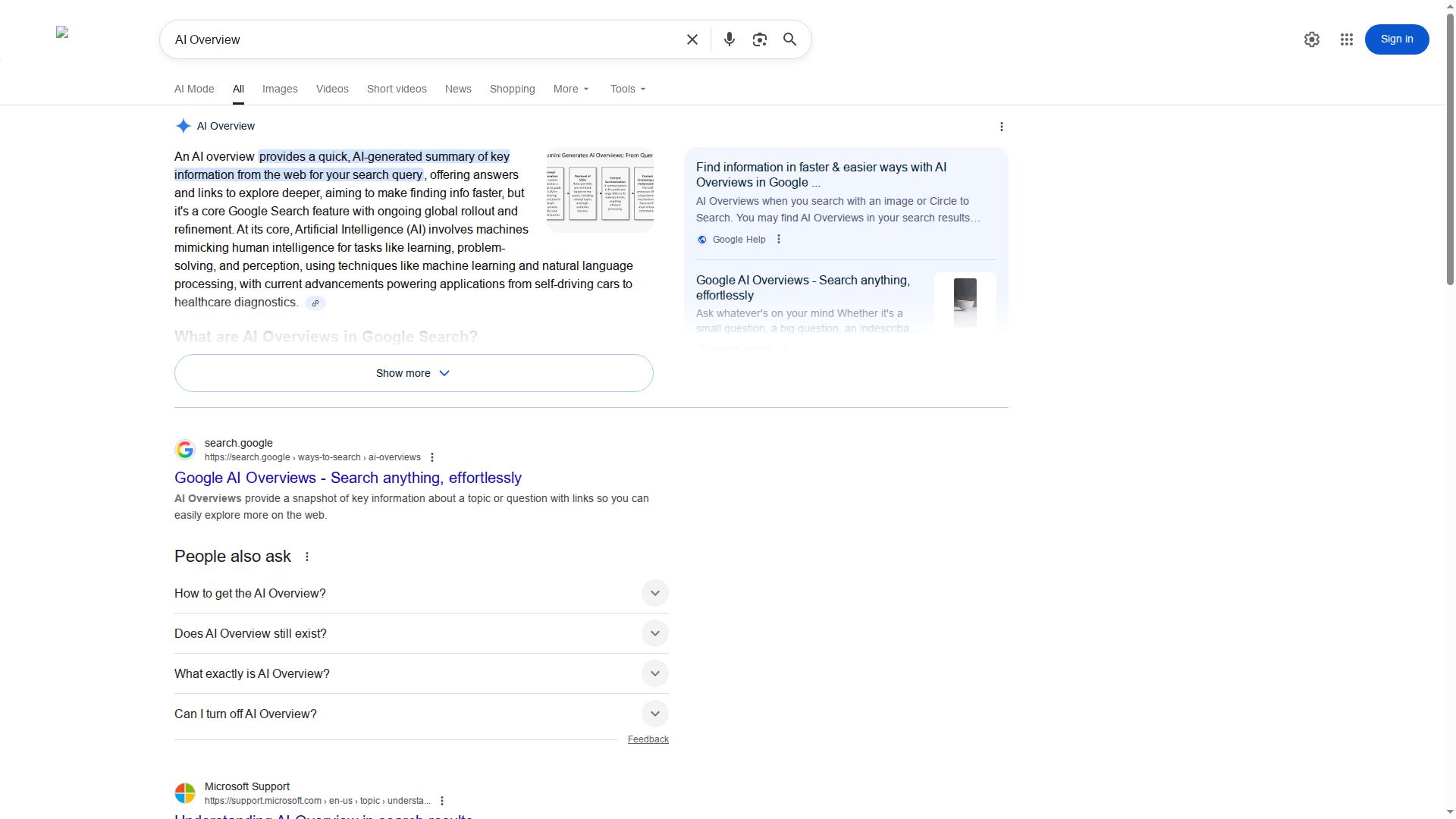
Above: Here’s a perfect example of an AI Overview on Google, showing how it pulls in sources and cites them directly.
To operationalize this, you cannot rely on old tools. You need to spot-check your top money keywords. Go to Google, go to ChatGPT Search.
Type in your queries. Are you there?
If not, your content might lack the specific structural elements these machines look for.
2. Entity and Brand Authority Signals
This is where things get technical, but stay with me. Search engines are moving away from strings (keywords) to things (entities).
They want to know who you are, what you do, and why you are an expert. This is why Entity Authority is firmly one of the most important SEO metrics for AI content.
If you write a blog post about "backlink automation," Google doesn't just scan for that phrase.
It looks at your site's history. Do you talk about SEO often? Are you linked to from other SEO experts?
Do you have an author bio that establishes credibility?
This is the Knowledge Graph in action.
Strengthening Your Knowledge Graph
Your goal is to become an immutable fact in the search engine's database.
You want the AI to "know" your brand like it knows the capital of France. You measure this by checking your presence in Knowledge Panels and the consistency of your Schema markup.
Tools like our RobotSpeed AI Content Agent don't just write words; they research deep topics to ensure your content covers the semantic spread necessary to build this authority. If you are missing key related entities in your content, the AI assumes you don't know the topic well enough to be a source.
Topical Authority Depth vs. Breadth
It is distinct from domain rating.
You can have a high domain rating but zero authority on a specific niche. For AI content, depth wins.
You need to dominate a topic completely.
Metric to track: Topical Coverage %. Think about it: if "AI Marketing" has 50 related sub-topics, how many have you actually covered with genuinely helpful, interlinked articles?
The higher this percentage, the more likely LLMs are to trust you as a comprehensive source.
| Metric | Old SEO Focus | AI SEO Focus |
|---|---|---|
| Authority | Domain Rating (DA/DR) | Entity Strength & Topic Coverage |
| Keywords | Exact Match Density | Semantic Context & Relationships |
| Links | Quantity of Backlinks | Relevance of Referring Entities |
Trying to build this kind of authority by hand is absolutely exhausting. This means planning out a content calendar to patch every single one of those gaps.
Honestly, this is where automation really shines, helping you map everything out so you don't leave any weak spots for competitors to sneak into.
3. Content Confidence and Freshness Scores
Here is a harsh reality: AI ignores stale content. When an LLM builds an answer, it prioritizes information that is current. It needs to be confident that the facts haven't changed.
This brings us to Content Confidence and Freshness.
You might have a great article from 2021, but if the data is old, an AI engine might skip it entirely for a newer, slightly worse article that has 2024-2025 data. This metric tracks how "alive" your site appears to the algorithms.
The Recency Trap
We are seeing that a massive percentage of citations in AI results come from content published or updated within the last 12 to 24 months.
If your strategy is "publish and forget," you are failing.
You need to track Freshness Rate: What percentage of your indexable content has been updated in the last year?
If it’s below 50%, you are likely losing visibility in AI Overviews. This is why we include automated refreshing and gaps analysis in our services.
Accuracy and Trustworthiness
This is a big debate: AI content vs human content accuracy. Search engines are getting better at detecting hallucinations or fluffy, value-void content. You need to measure the factual density of your posts.
Does your content cite sources?
Does it use statistics?
Or is it just opinion?
High confidence scores come from content that looks like research.
The team at Techmagnate's also talking about AI SEO, and they've found that getting your facts straight and citing credible sources are now major tickets to getting selected by AI.

When you are checking your metrics, look at the engagement on your "fresh" content versus your legacy content. You will likely see a divergence. The fresh content gets picked up; the old content fades.
4. Intent Satisfaction and Engagement Depth
It is easy to get traffic. It is hard to keep it.
In the context of the most important SEO metrics for AI content, Intent Satisfaction is the king of retention. Google calls this "Hidden Gems" or "Helpful Content," but it really boils down to: Did the user find what they needed?
If a user clicks your link from an AI answer, they expect immediate value.
If they bounce back to the search results instantly (Pogo-sticking), the AI learns that your source was bad. It won't cite you next time.
Measuring Introduction Retention
We look closely at "Time to Value." How many seconds does it take for the user to get the answer?
If you bury the lead under 500 words of fluff, you lose.
For AI traffic, the bounce rate isn't always bad (they might have found the phone number they needed), but generally, you want to see engagement.
Track Scroll Depth. Are people reading to the bottom? Are they engaging with your tools?
Use heatmaps. If the AI sends you traffic, you need to prove to the algorithm that the traffic was satisfied.
The Shift in User Behavior
Users coming from AI are often more impatient.
They utilize the AI to filter out the noise.
If they click you, they deem you the signal. Don't disappoint them.
Experts at StoryChief highlight that intent alignment is critical in 2025. You can't just trick someone into visiting; you have to serve the exact intent (informational, transactional, etc.) immediately.
Practically, this means formatting matters.
Bullet points, bold text for key insights, and clear data tables help both the user and the AI parse your information quickly.
5. Business Outcomes per AI Visit
Finally, let's talk about money.
Traffic is a vanity metric if nobody buys anything. This is the ultimate metric: Business Outcomes per AI Visit.
You might see traffic drop by 20% due to AI Overviews, but if your conversion rate doubles, you are winning.
You need to set up your analytics to champion value over volume. Segment your traffic. Look specifically at referrals from AI sources (if identifiable) or organic traffic landing on your high-intent pages.
Tracking ROI Properly
When businesses ask how to measure ROI from AI SEO 100 backlinks, they are often looking for a direct line between a link and a dollar.
It is rarely that linear. But you can track the lift in domain authority and the subsequent increase in high-intent keyword rankings.
You should focus on Conversion Rate by Source. Often, AI-driven traffic converts higher because the intent is higher.
A user asking specific questions to an LLM is further down the funnel than a user typing a generic keyword into a search bar.
Efficiency Metrics
Another angle is cost efficiency. If you use RobotSpeed to automate your content, your cost per acquisition (CPA) for organic leads should drop drastically. Creating content manually is expensive.
Automating it improves your margins.
Consider the logic here. If you spend $500 on a human writer for one post, you need a lot of conversions to break even. If you spend that same amount on a subscription that generates 30 posts, your "break-even" point for ROI is significantly lower.
This efficiency is a metric in itself.
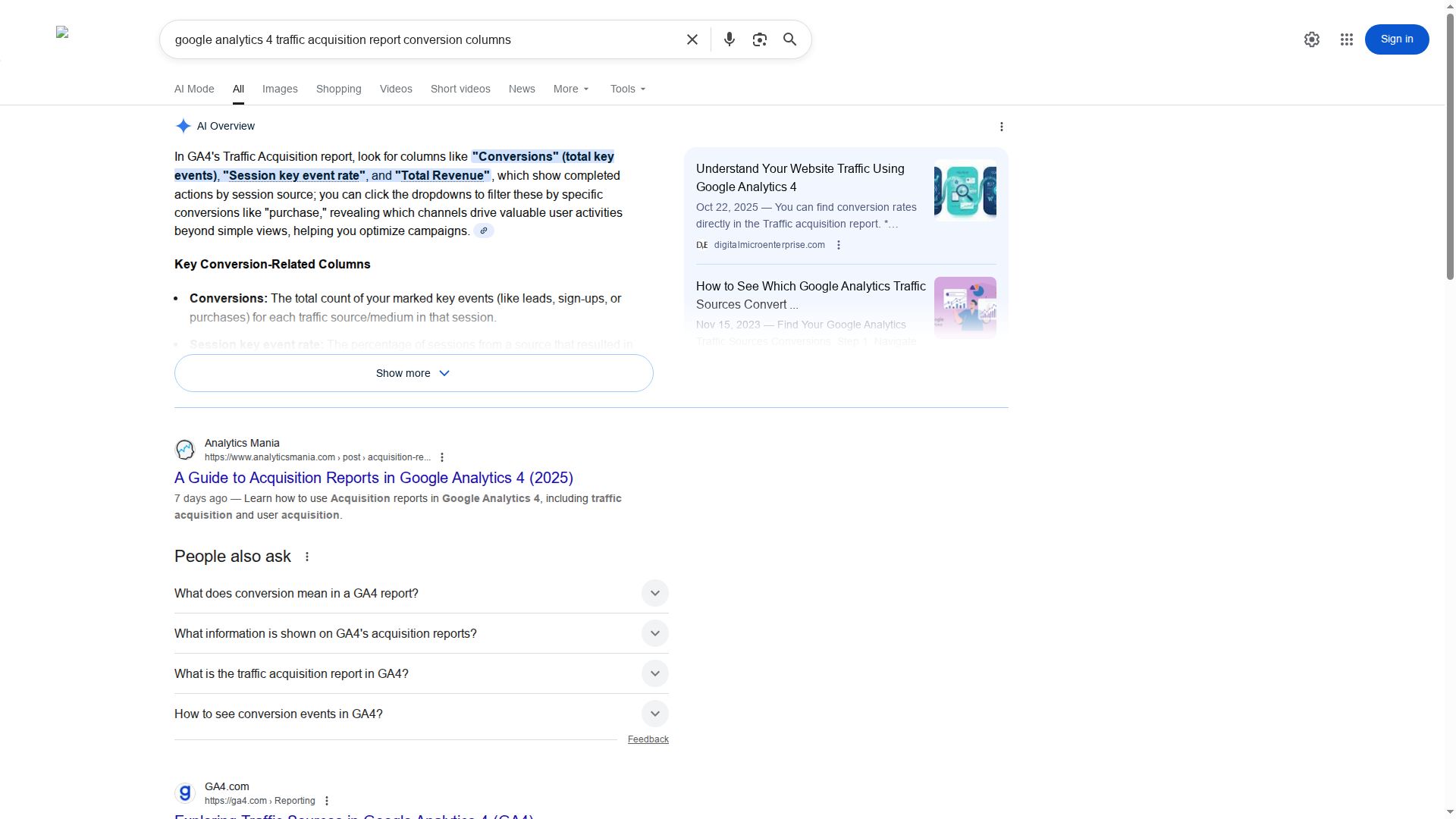
Above: Monitoring conversions specifically from organic search channels is vital to proving ROI.
The Technical Reality of AI Content
We haven't touched enough on the technical foundation yet. None of the metrics above matter if your site is slow or broken. AI crawlers are voracious but impatient.
The speed at which your content is served impacts your "Crawl Budget" and indexing speed.
Your Core Web Vitals (CWV) are a prerequisite. It is like trying to enter a race; if your car doesn't start, it doesn't matter how good the driver is.
Ensure your LCP (Largest Contentful Paint) is under 2.5 seconds. Faster sites are easier for AI to digest and index.
Structured Data is Your Translator
Think of Schema markup as the translator between your content and the AI brain. You might write a brilliant article, but without Schema, the AI has to guess the context. With Schema, you are explicitly telling it: "This is an article," "This is the author," "This is the publication date."
We see a direct correlation between robust implementation of Article, FAQ, and Product schema and inclusion in AI Overviews. It removes the ambiguity.
AI hates ambiguity.
Why Backlinks Still Matter (But Differently)
You might hear rumors that backlinks are dead.
They aren't. They have just changed jobs.
In the past, backlinks were votes of popularity. Now, they are validators of authority. This is critical when discussing the most important SEO metrics for AI content.
An AI model determines the trustworthiness of facts based on the consensus of the web. If you make a claim, and five authoritative sites link to you, the AI treats your claim as a verified fact.
If nobody links to you, it's just a rumor.
This is why our Premium Link Network integration is popular. It’s not about spamming thousands of links. It’s about securing relevant, high-quality exchanges that signal to the AI: "This domain is a trusted node in the network."
Operationalizing These Metrics: A Weekly Routine
You can't monitor everything every day. You'll go crazy. But you need a rhythm.
Here is what we see successful international businesses doing with a mid-range budget.
- Weekly: Check AI Visibility. Spot check your top 5 money keywords in Google and ChatGPT. Are you showing up?
- Monthly: Audit your Freshness. Which key articles haven't been touched in 6 months? Schedule them for a refresh using the Content Agent.
- Quarterly: Deep dive into Business Outcomes. Is the organic traffic actually converting? If not, adjust the intent targeting.
It sounds like a lot of work, and frankly, doing it manually is. That is the bottleneck most companies face.
They know what to do, but they lack the hours in the day to execute.
This is where the leverage of automation comes in.
You aren't replacing the strategy; you are automating the grunt work so you can focus on the strategy.
The Human Edge in an AI World
Paradoxically, the more AI content floods the web, the more valuable "human" touches become.
We aren't talking about writing casually; we are talking about unique insights. Data that only you have.
Stories that only you can tell.
When you use our tools to generate content, you should always review it. Add that specific percentage user increase you achieved for a client.
Add that quote from your CEO. These unique data points are what prevent your content from becoming a commodity.
The AI metrics reward uniqueness because it stands out in the training data.
Think about it. AI predicts the next word based on probability. It writes the "average" expert article.
To beat the average, you must inject something unpredictable but high-value. That combination, AI efficiency plus human insight, is unbeatable.

Walls.io / Unsplash
Conclusion: Adapt or Disappear
The landscape of search is unforgiving to those who stand still. The most important SEO metrics for AI content, Visibility, Authority, Freshness, Satisfaction, and Outcomes, are your new dashboard.
They replace the simplistic rank tracking of the past decade with a more nuanced, holistic view of digital health.
You have a choice. You can keep chasing rankings that no longer exist, or you can start optimizing for the answer engines that are defining the future. It requires a shift in mindset and a shift in tooling.
If you are ready to stop guessing and start scaling your authority 40x faster than your competitors, it’s time to look at automation. We built RobotSpeed specifically for this transition. We handle the heavy lifting of research, writing, and linking so you can focus on the metrics that actually move the needle.
Don't let the shift to AI leave your business behind. Take control of your visibility today.
FAQ: SEO Metrics for AI Content
Q: Can I just track Google rankings in 2025?
A: Not anymore. Rankings still give you a piece of the puzzle, but they won't show you if you're visible in AI Overviews or being used for answers in LLMs like ChatGPT, which are gobbling up a huge share of search traffic.
Q: How does backlink automation help with AI SEO?
A: It all comes down to signaling authority.
Using automated exchanges helps you build domain authority way faster, which tells AI systems that your site is a trustworthy source worth citing.
Q: What is the difference between AI content and human content accuracy?
A: The biggest risk is that AI can sometimes just make things up (what we call 'hallucinations') or lean on outdated information.
That's why having a human in the loop for verification and editing is so important; it's what guarantees the kind of accuracy that search engines are rewarding these days.
Q: Is dwell time important for AI content?
A: Absolutely.
If a user clicks from an AI answer to your page and then hits the back button right away, it tells the algorithm your content didn't deliver the goods.
That's a bad signal that can hurt your visibility down the road.
Q: How often should I update my content?
A: For your most important pages, a good rule of thumb is to give them a refresh every 3 to 6 months. Freshness is a massive ranking signal for today's Answer Engines.