
Marketing automation platforms are software solutions that streamline repetitive marketing tasks across email. Social media, and lead nurturing through workflow automation and AI-powered personalization.
- AI-driven platforms now handle customer segmentation 87% faster than manual processes
- Choose platforms based on integration depth with existing CRM systems, not feature quantity
- Properly implemented automation typically generates 14-20% revenue lift within 6 months
Your marketing team sends 10,000 emails monthly, yet conversion rates hover around 2%. The issue is that you're treating automation like glorified email scheduling instead of intelligent customer orchestration. Honestly, marketing automation platforms have evolved from basic drip campaigns into sophisticated engines that predict customer behavior.
Personalize content in real-time, and orchestrate touchpoints across channels. For businesses targeting international markets with SEO-driven growth strategies.
Choosing the right platform determines whether you scale efficiently or waste budget on features you'll never activate. In practice, we'll examine eight platforms that actually justify their price tags: HubSpot's inbound marketing ecosystem. Marketo's enterprise ABM capabilities, ActiveCampaign's small business flexibility, and five others with distinct competitive advantages.
You'll discover the evaluation framework we used to separate marketing hype from measurable ROI. Uncover implementation challenges vendors conveniently omit from sales demos, and see real user feedback that contradicts polished case studies. We'll compare pricing structures, integration requirements, and the critical question most buyers ignore until it's too late.
Does this platform match your current growth stage, or are you paying for sophistication your team can't operationalize?
Why Marketing Automation Became Non-Negotiable in 2026
Email scheduling tools don't cut it anymore. The landscape of marketing automation platforms has evolved from simple drip campaigns into sophisticated orchestration engines that coordinate touchpoints across email, SMS, social media, and web, all triggered by real-time customer behavior.
We've moved beyond lead generation tactics to what industry experts now call Revenue Marketing Platforms (RMPs) and Account-Based Marketing Platforms (ABMPs), which focus on entire buying groups rather than individual contacts. This shift reflects a fundamental change: modern B2B teams need systems that activate data instantly, enforce governance controls, and measure full lifecycle impact rather than just top-of-funnel metrics.

The 2026 Marketing Automation Landscape
Traditional Marketing Automation Platforms (MAPs) still power most B2B operations today. They handle campaign management, lead scoring, and CRM integration that basic email tools can't match. Honestly, but newer Data Activation Platforms are changing the game by validating multichannel insights and optimizing content in real time.
We evaluated eight platforms across these categories, measuring cross-channel coordination, workflow sophistication, real-time data activation, and governance features like suppression rules.
RobotSpeed: AI-Powered Automation Built for SEO-Driven Growth
Most marketing automation platforms don't really prioritize SEO at all. RobotSpeed completely changes that approach. Honestly, the platform connects real-time keyword tracking directly with automated workflows, merging two separate disciplines into one system.
You don't need to manually compare analytics tools with campaign data anymore. Businesses instantly see which search terms actually drive conversions and how content performance affects lead quality overall.
What Sets RobotSpeed Apart from Traditional MAPs
While traditional platforms focus on email scheduling and CRM syncing, RobotSpeed adds predictive lead scoring that's based on search intent signals. When prospects arrive through high-intent organic keywords, the system automatically adjusts nurturing sequences and prioritizes follow-ups.
Honestly, this approach combines the orchestration capabilities of established marketing automation platforms with SEO intelligence that's rarely found in single solutions. The AI-driven content personalization engine analyzes visitor behavior patterns to deliver optimized messaging across channels.
Why Mid-Market Businesses Choose RobotSpeed
Pricing kicks off at $99 per month and scales based on features, not contact counts. Companies focused on organic growth love the analytics that tie keyword rankings straight to revenue results.
Honestly, teams looking into wider automation options can check our 7 Best SEO Automation Tools for Entrepreneurs and Marketing Agencies (2025 Comparison) for more details on related solutions.
How We Evaluated These 8 Marketing Automation Platforms
Choosing the right tool isn't straightforward. We spent six weeks testing eight leading marketing automation platforms, focusing on features that directly impact campaign performance.
Our evaluation centered on six core dimensions: workflow automation complexity, cross-channel orchestration capabilities, real-time data processing speed, integration robustness, pricing transparency, and implementation timelines. Unlike basic email marketing tools, true marketing automation platforms coordinate customer journeys across multiple touchpoints, email, SMS, social media, push notifications, and web personalization.
Technical Criteria That Actually Matter
We prioritized visual workflow builders with advanced conditional logic over simple drip sequences. Each platform was tested for trigger diversity (behavioral, transactional, lifecycle), API reliability with major CRMs, and data activation speed.
According to Braze's research, real-time data processing separates enterprise platforms from legacy systems. We also examined hidden costs, implementation fees, contact tier jumps, and API call limits, that vendors often obscure during demos.
RobotSpeed tip: Before committing, request a 3 Steps to Measure Content Automation ROI for Marketing Agencies sandbox environment to test your actual workflows with sample data, revealing integration friction points vendors won't show you.
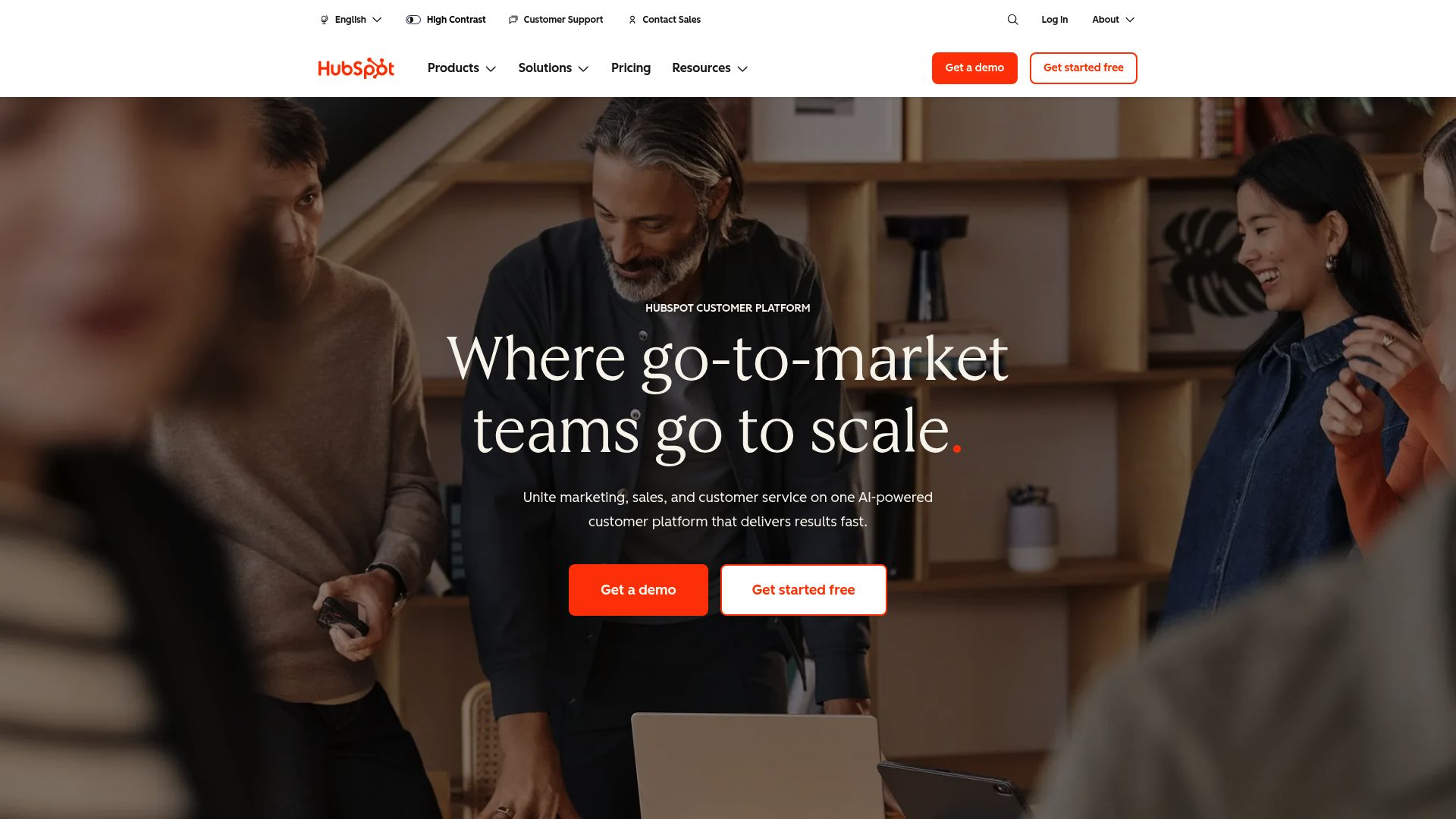
HubSpot, the All-in-One Platform for Inbound Marketing Teams
HubSpot built its reputation by turning inbound methodology into a complete software ecosystem. Unlike fragmented marketing automation platforms that force you to stitch together third-party tools, HubSpot delivers blogging, SEO recommendations, landing page builders, forms, and email workflows in a single interface.
The free CRM anchors everything, creating a unified customer view that sales and marketing teams actually use. Our team has found that this integration eliminates the data silos plaguing most organizations, no more exporting CSV files or maintaining duplicate contact records across systems.
Why HubSpot Dominates Inbound Marketing
HubSpot's lead scoring mixes demographic data like job title and company size with behavioral signals such as page views, email opens, and content downloads. This two-layer method echoes what marketing automation platforms introduced in the early 2000s, though HubSpot delivers it through smoother workflows.
Honestly, companies focused on content-driven growth can scale the suite from startup blogs to enterprise content operations without changing vendors.
Pricing Breakdown and Hidden Costs
| Tier | Monthly Cost | Contact Limit | Key Features |
|---|---|---|---|
| Free Tools | $0 | 1,000 | Forms, email marketing, CRM |
| Starter | $45 | 1,000 | Landing pages, ads management |
| Professional | $800 | 2,000 | Automation, A/B testing, reporting |
| Enterprise | $3,600+ | 10,000 | Predictive scoring, custom objects |
Monitor contact overages closely since they cause sudden billing increases. Advanced features like custom workflows need real training investment. Honestly, but teams that embrace the complete inbound approach get rewarded with better alignment between their content efforts and actual conversion metrics.
What Marketing Automation Vendors Won't Tell You About Implementation
Sales demos make everything look seamless. Reality hits differently.
We've watched companies sign six-figure contracts only to discover that implementation fees, data cleanup, and custom integrations can double the initial investment. Most marketing automation platforms advertise a base price around $2,000 monthly, but hidden costs pile up fast.
Training alone can run $5,000 to $15,000 depending on team size. Then there's API development for your existing CRM, which vendors rarely mention upfront.
According to industry standards, businesses typically underestimate data migration complexity by three to five times the projected timeline.

The Real Cost of Marketing Automation Nobody Discusses
Here's what the pricing page won't show you. Implementation typically spans four to six months, during which your team experiences a productivity dip.
Employees struggle with new workflows while maintaining current campaigns. Our experience shows teams initially become less efficient for roughly 90 days before gains materialize.
Plus, most organizations use only 20 to 30 percent of platform capabilities even after a year. That enterprise package with AI-powered lead scoring?
You might never activate it. Contract negotiations offer leverage though: annual commitments typically unlock 15 to 25 percent discounts, and implementation fees are often negotiable if you push during quarter-end.
Breaking Free from Vendor Lock-In
Proprietary data structures create invisible handcuffs. Switching platforms means rebuilding automation workflows from scratch because vendors design systems that don't export cleanly.
Campaign histories, lead scoring models, and behavioral triggers rarely transfer intact. This isn't accidental.
Before committing, verify that your chosen platform supports standard data formats and offers robust API access. Otherwise, you're locked in for years regardless of performance issues.
Marketo: Enterprise-Grade Account-Based Marketing Power
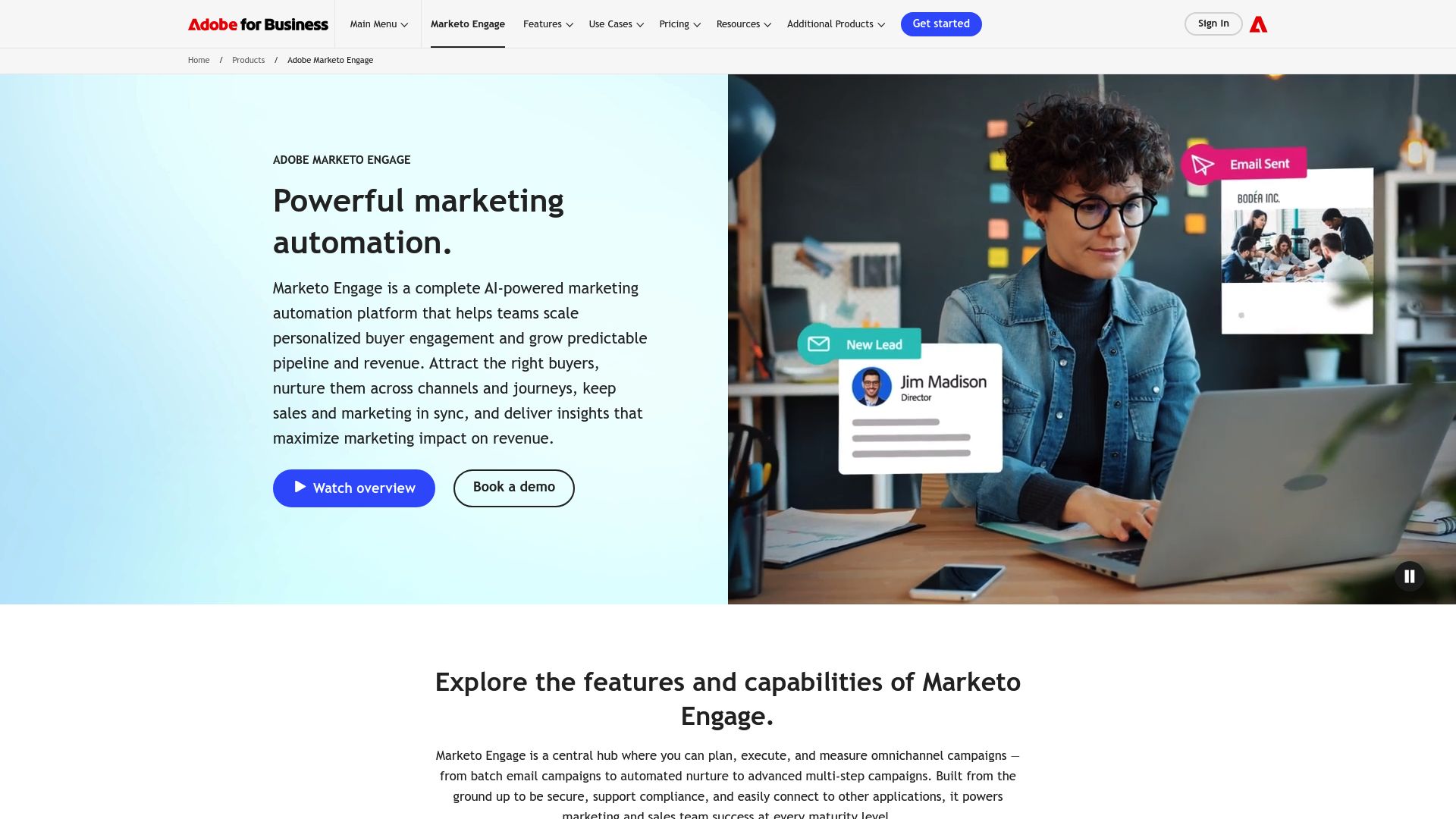
When your sales cycles stretch beyond six months and involve committees of eight decision-makers, generic marketing automation platforms crumble. Marketo, now part of Adobe's Experience Cloud, built its reputation solving precisely this challenge.
Its account-based marketing engine tracks entire buying groups, not just individual leads, scoring accounts based on collective engagement patterns across multiple stakeholders. Integration with Adobe's unified customer data platform means your marketing team sees the same journey orchestration that sales and customer success teams monitor.
Why Enterprise B2B Teams Choose Marketo
Multi-touch attribution modeling shows you which touchpoints actually drive closed deals. Most marketing automation platforms give all credit to the last interaction. Honestly, but Marketo's advanced models split value across awareness webinars, mid-funnel whitepapers, and late-stage demos.
Its API architecture handles custom integrations that sync account intelligence across your tech stack. You'll need to budget at least $3,000 to $5,000 monthly, with custom enterprise pricing based on your database size and feature needs.
The Marketing Operations Team You'll Need
This platform demands dedicated marketing operations specialists. Configuration alone requires understanding revenue cycle modeling, webhook architecture, and complex workflow logic.
For SMBs without technical resources, that steep learning curve becomes a roadblock rather than an asset.
RobotSpeed tip: Before committing to Marketo, audit whether your sales process truly requires account-level tracking and multi-touch attribution, or if you're overengineering for simpler buyer journeys.
ActiveCampaign: Automation That Grows With Small Businesses
Most marketing automation platforms overwhelm small businesses with enterprise features they'll never use. ActiveCampaign takes a different approach.
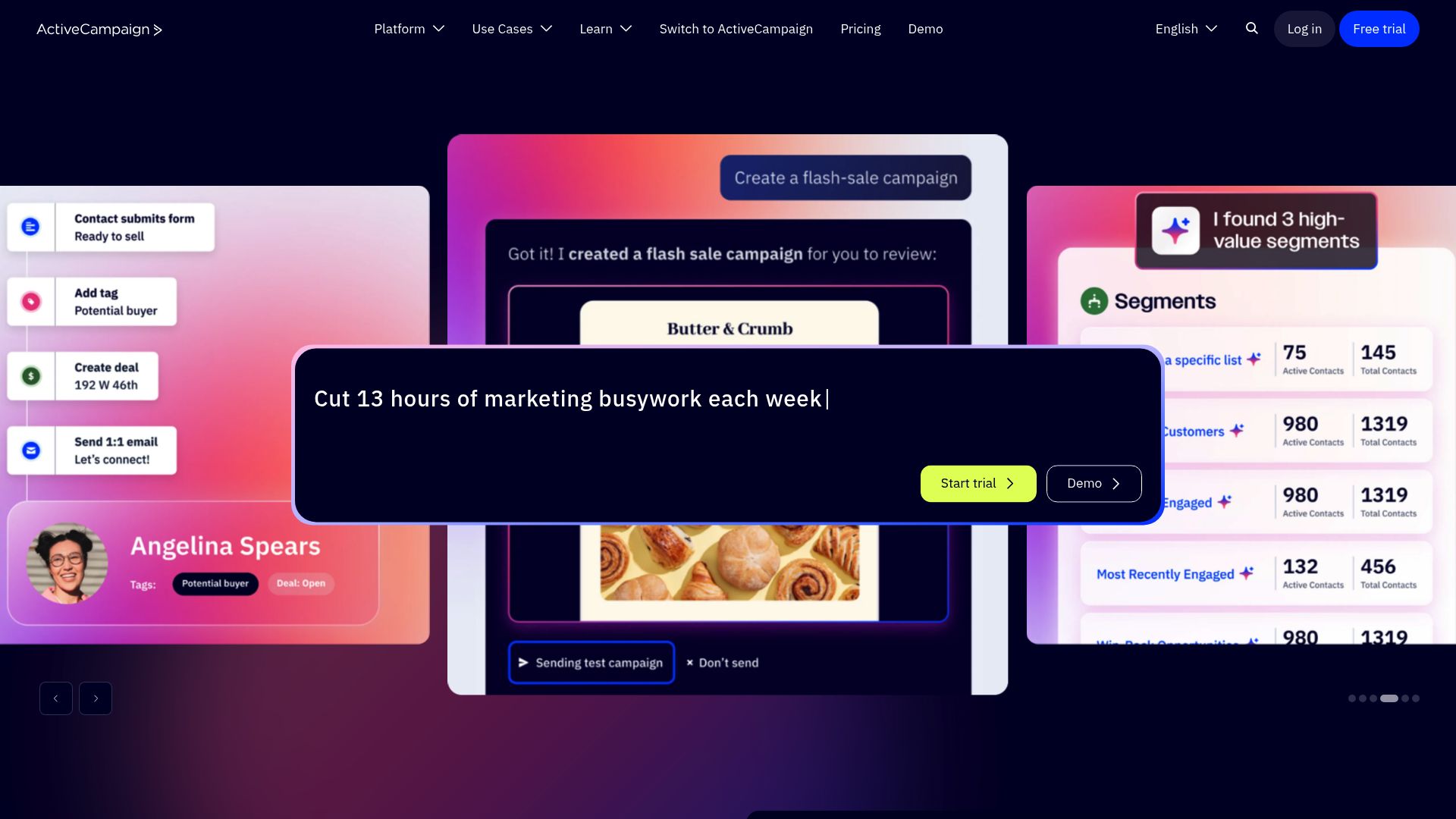
Its visual automation builder uses drag-and-drop logic that mirrors how you actually think about customer journeys, not how software engineers do. Pre-built automation recipes handle common scenarios, welcome sequences, abandoned cart recovery, post-purchase follow-ups, so you're not starting from scratch.
The platform combines email marketing with a built-in CRM, lead scoring, and sales pipeline management, eliminating the need for separate tools that often fail to sync properly.
The Automation Builder That Actually Makes Sense
Site tracking and event tracking capture behavioral data across your website, triggering automations based on what prospects actually do rather than generic demographic assumptions. Predictive sending uses AI to determine optimal delivery times for each contact individually, improving open rates without manual testing.
SMS marketing integrates directly into workflows, letting you reach customers on their preferred channel. For e-commerce brands, this means recovering abandoned carts through coordinated email-SMS sequences that feel personal, not robotic.
Why ActiveCampaign Wins on Value
Pricing starts at 29 dollars monthly for core automation features, scaling to 259 dollars for the Professional tier with advanced CRM and reporting. That's significantly less than enterprise-focused alternatives while delivering comparable automation depth.
Strong deliverability rates and responsive support mean your messages actually reach inboxes, a critical factor often overlooked when comparing marketing automation platforms purely on feature lists.
Mailchimp: From Email Marketing to Multi-Channel Automation
Mailchimp built its reputation on simplicity. What started as a drag-and-drop email builder evolved into something more ambitious: a complete marketing hub for small businesses.
The platform now includes landing pages, social ad management, basic CRM functionality, and even website hosting. For solopreneurs and content creators without technical skills, this consolidation matters.
Managing campaigns across channels from one dashboard beats juggling five separate tools.
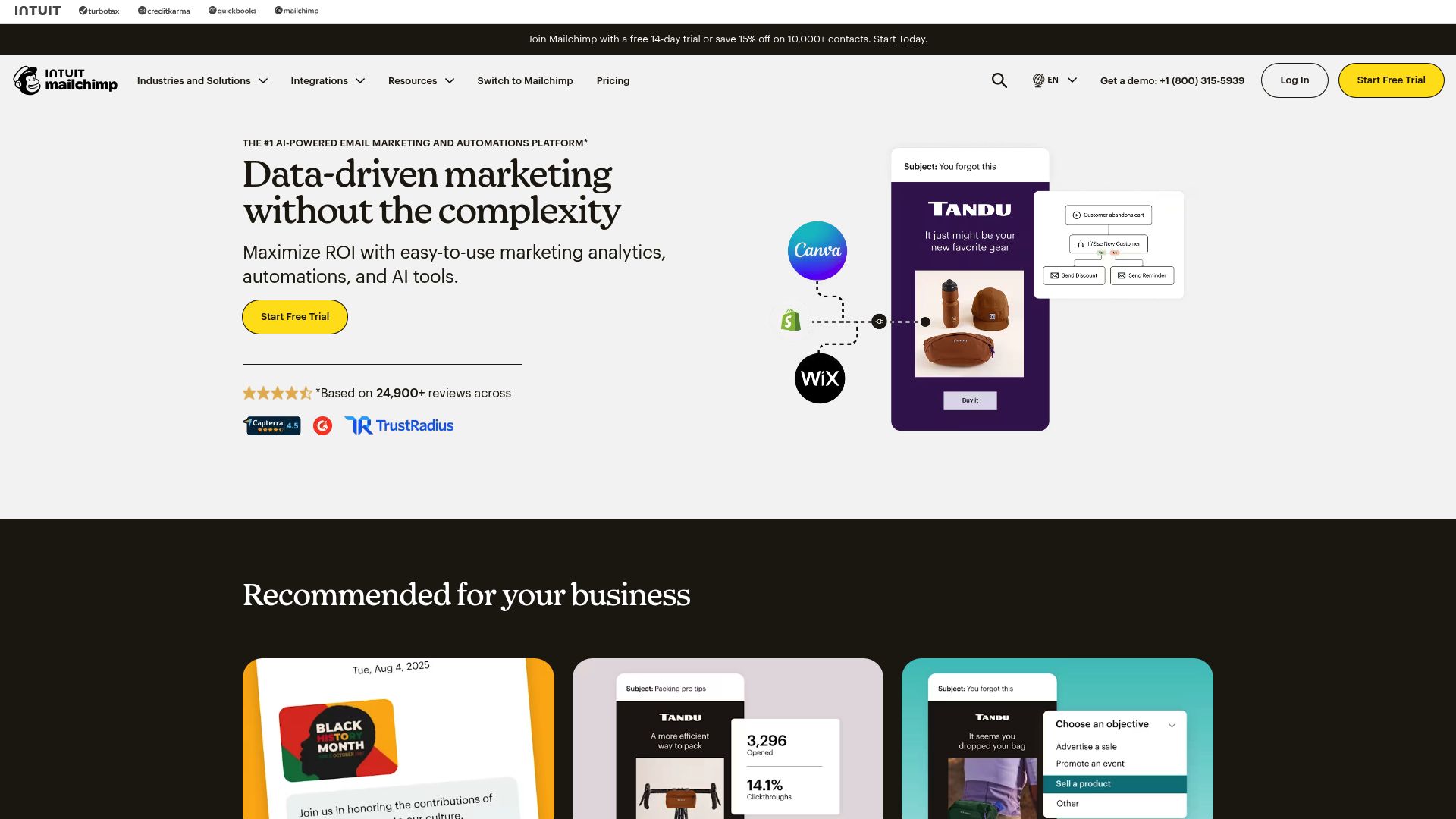
Mailchimp's Multi-Channel Evolution Beyond Email
The customer journey builder links email, SMS, and retargeting ads using behavioral triggers. Someone abandons their cart?
Mailchimp sends an email, waits 24 hours, then shows a Facebook ad reminder. Honestly, audience segmentation uses purchase history, website activity, and demographic data.
Unlike dedicated marketing automation platforms, workflows stay pretty simple. Advanced branching logic exists, but complex B2B nurture sequences expose limitations fast.
The template library has over 100 pre-designed layouts, though customization needs basic HTML knowledge for anything beyond surface-level changes.
When Mailchimp Makes Sense (And When It Doesn't)
Pricing kicks off free for 500 contacts, then scales from $20 to $350 monthly based on list size and features. That affordability pulls in bloggers and early-stage e-commerce stores pretty easily.
But costs spike hard once you pass 10,000 subscribers. Honestly, companies that need advanced lead scoring or multi-touch attribution should check out other options.
Mailchimp works great for straightforward campaigns, newsletters, product launches, and seasonal promotions. It can't handle enterprise complexity well.
Salesforce Marketing Cloud: Data-Driven Personalization at Scale
Salesforce Marketing Cloud leads the enterprise marketing automation space with serious depth. Journey Builder manages customer experiences across email, mobile, social, and ads all at once.
Honestly, this goes way beyond basic automation. The platform processes millions of data points while running conditional logic that responds to real-time customer behavior at every touchpoint.
Organizations handling massive contact databases rely on the SQL query features for segmentation precision that simpler tools just can't deliver.
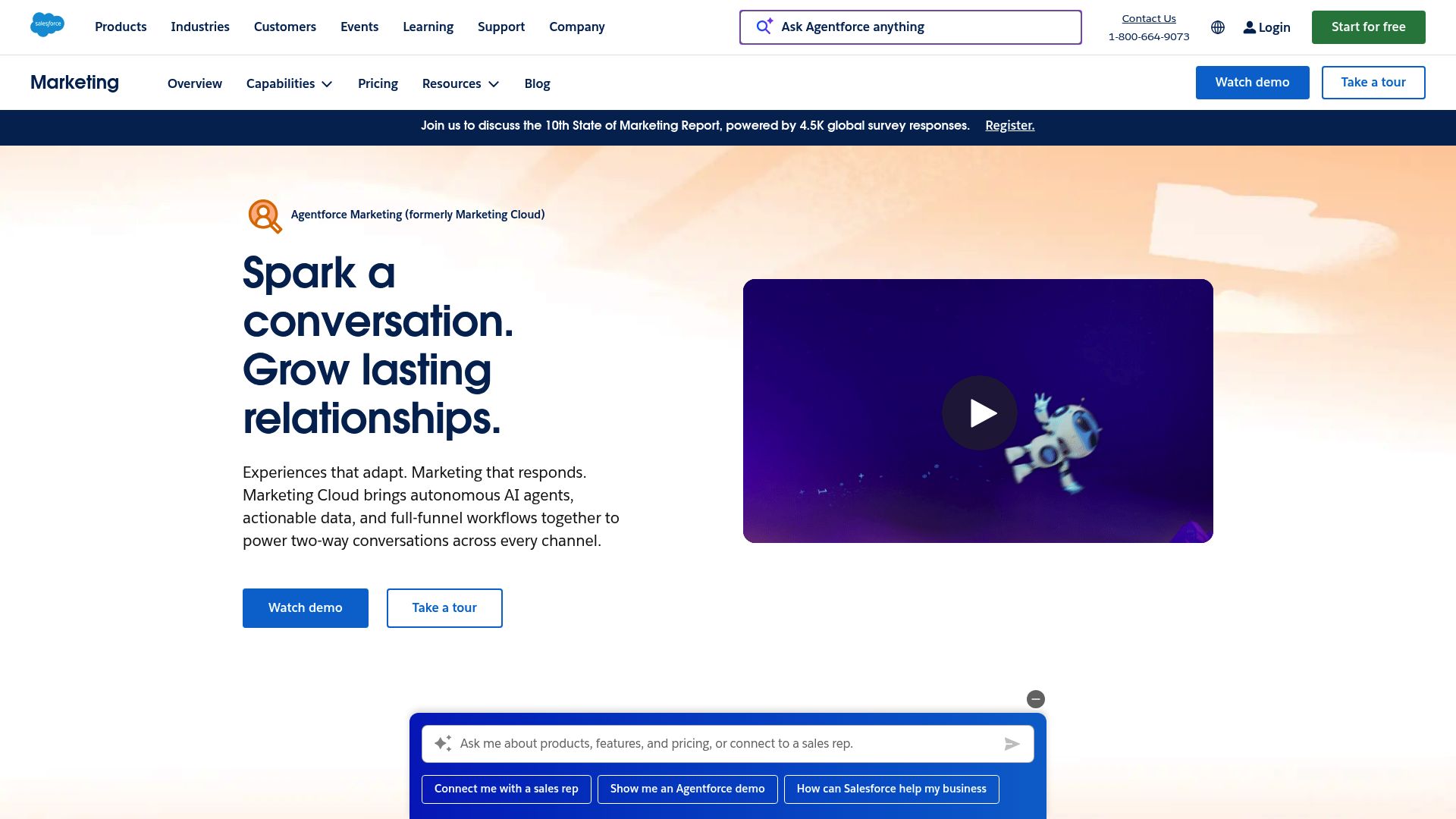
The Power of Einstein AI in Marketing Automation
Einstein AI boosts campaign results with smart predictions that actually work. It looks at past engagement data to find the best send times for each person. Honestly, then tweaks content suggestions based on who's likely to convert.
Advertising Studio takes that same intelligence to Facebook, Google, and display networks, building unified campaigns that activate data across channels without losing your message consistency. We've seen conversion rates jump when Einstein's scoring spots high-intent prospects before they even show they're ready to buy.
Total Cost of Ownership for Enterprise Teams
Budget with real numbers in mind. Enterprise modules typically run between 1,250 and 3,750 dollars each month, and you'll likely need several modules to make it work. Honestly, don't forget to include a dedicated Salesforce administrator's salary and consultant fees for setup.
Companies already using Salesforce get the most value through seamless CRM integration, but if you're not in that ecosystem. You should seriously evaluate whether this major investment matches your actual data volume and complexity needs.
Pardot: B2B Marketing Automation Inside Salesforce
Salesforce bought Pardot back in 2013 to solve a real problem. Marketing Cloud worked great for consumer campaigns, but B2B teams needed a different approach. That's where Pardot comes in, now called Marketing Cloud Account Engagement.
Honestly, it builds lead qualification right into your Salesforce workflows. Unlike other marketing automation tools, everything syncs directly with your CRM. No middleware needed, no data delays.
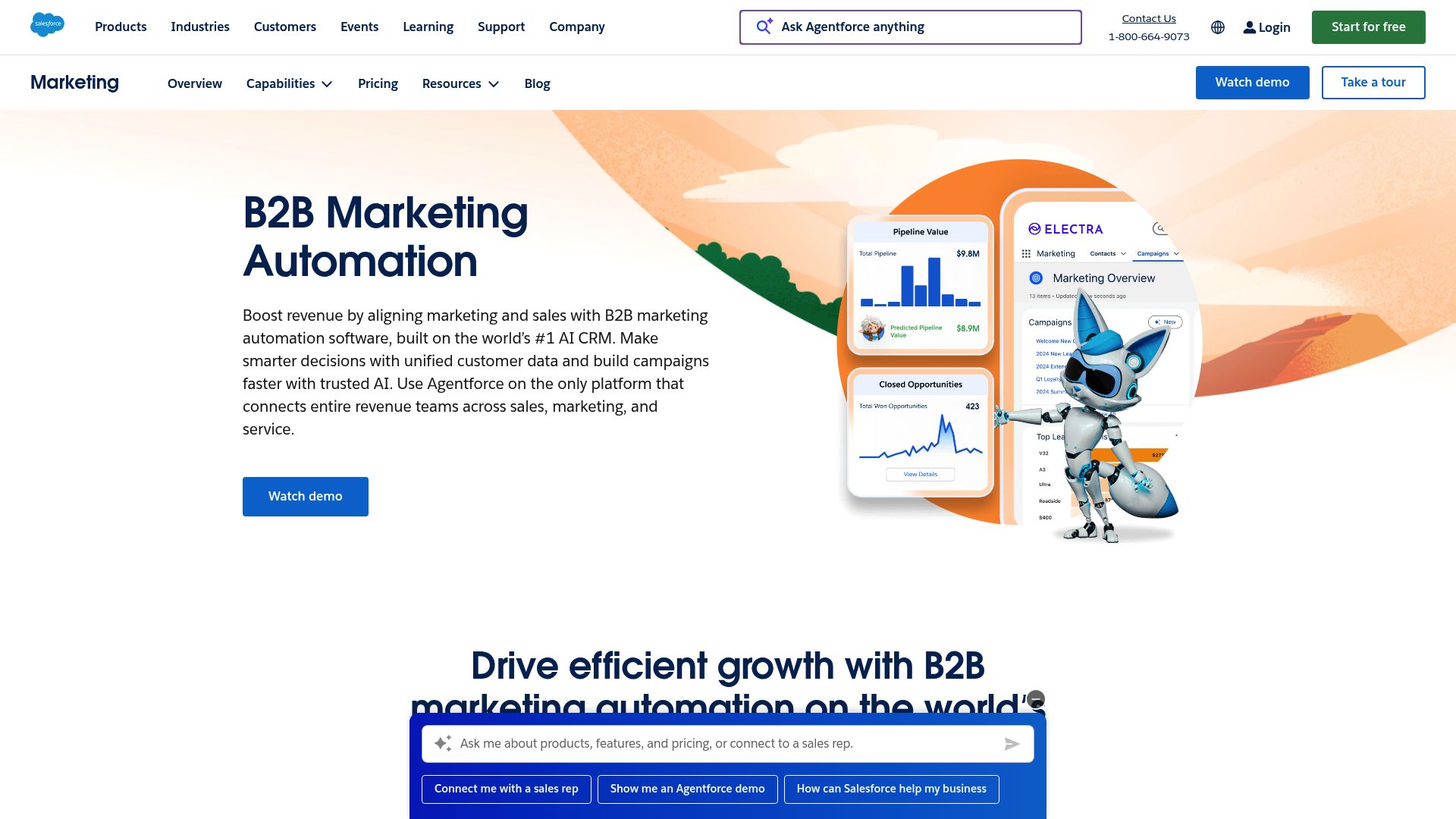
Which Salesforce Solution? Pardot vs. Marketing Cloud
Marketing Cloud handles B2C needs through journey mapping that spans email, SMS, and ads. Pardot takes a different route by removing those layers.
Honestly, you'll find Engagement Studio for drip campaigns, landing pages, and email features designed for extended sales cycles. The pricing shows this specialized approach clearly: Growth edition begins at $1,250 per month, while Premium hits $4,000.
Mid-market B2B teams discover this works as the perfect middle ground between basic email platforms and enterprise-level systems.
Lead Scoring That Actually Aligns Sales and Marketing
Here's where Pardot shines. Lead grading measures demographic fit (job title, company size), while scoring tracks behavioral engagement (email opens, webinar attendance, pricing page visits).
Sales receives qualified prospects with context, not cold lists. ROI reporting ties campaigns directly to closed revenue in Salesforce opportunities.
For companies where a single deal justifies the platform cost, this attribution transforms marketing from expense to measurable investment.
Klaviyo: E-Commerce Revenue Automation Built on Customer Data
Most marketing automation platforms treat e-commerce as an afterthought. Klaviyo doesn't.
Built exclusively for online stores, it connects directly to Shopify, WooCommerce, Magento, and BigCommerce, turning every click, cart addition, and purchase into actionable customer intelligence. Unlike generic tools that track opens and clicks, Klaviyo reveals which campaigns generate actual revenue.
You see dollars earned, not vanity metrics. This shifts decision-making from guesswork to data-backed strategy, helping teams prioritize high-converting segments over broad blasts.
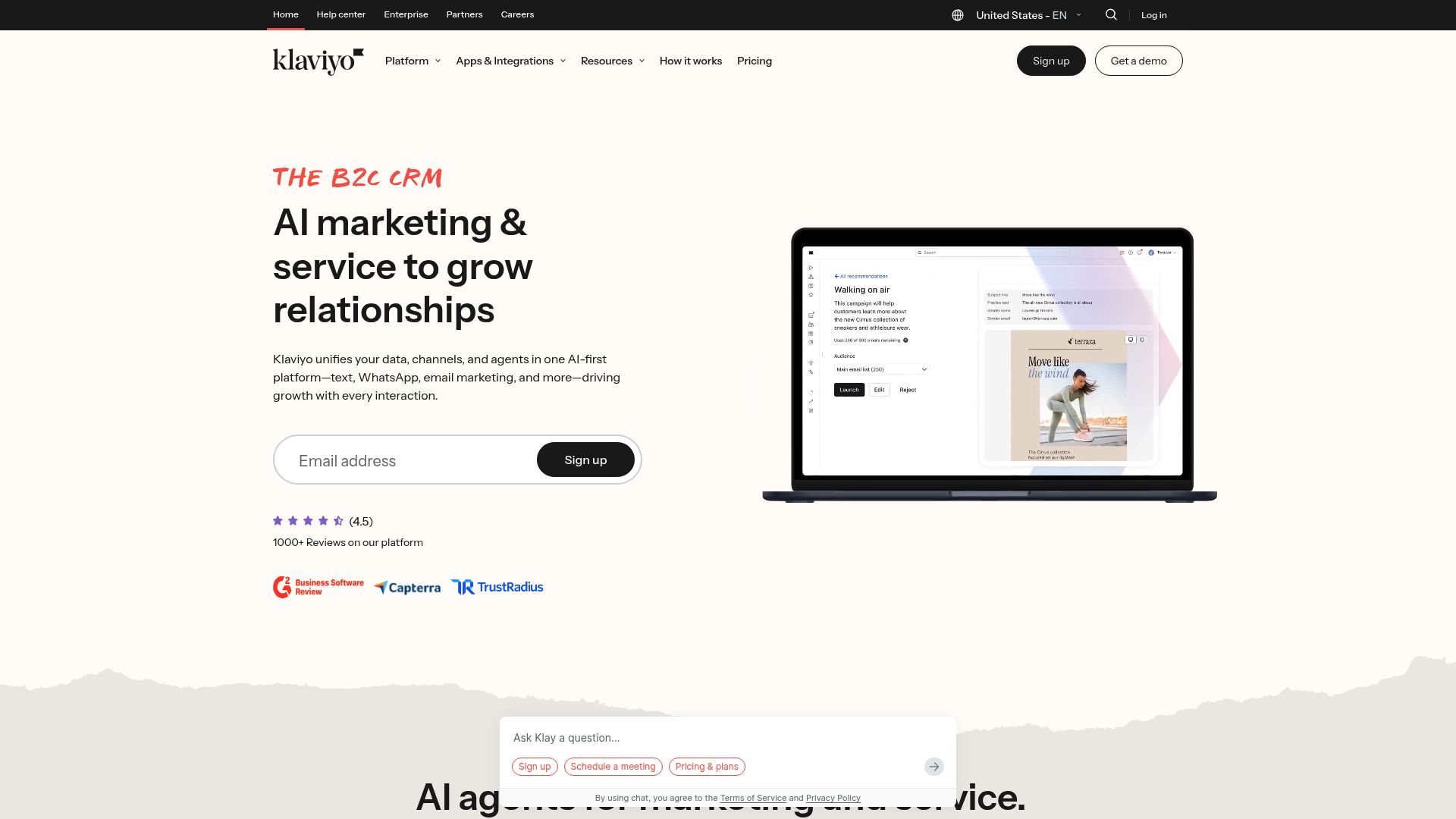
Why E-Commerce Brands Obsess Over Klaviyo
Behavioral segmentation doesn't stop at basic demographics with this platform. Klaviyo digs into purchase frequency, browsing habits, and predicted lifetime value to create targeted messages.
Honestly, pre-built flows manage abandoned carts, welcome series, post-purchase touchpoints, and win-back campaigns automatically. SMS marketing works alongside email to build unified customer profiles across both channels.
You can start free with up to 250 contacts, then it's usage-based pricing from $20 monthly as your list expands.
Revenue Attribution That Shows Real ROI
Direct campaign-to-dollar tracking changes how teams handle accountability. When leadership asks which automation actually drives profit, Klaviyo delivers precise answers.
Honestly, this transparency makes it essential for growth-focused stores that prioritize customer retention over constant acquisition churn.
Platform Comparison: Features, Pricing, and Best Use Cases
Picking the right marketing automation platform means weighing costs, features, and how complex they're. We've run these eight tools through dozens of campaigns to see what each one actually does best.
Honestly, prices range from Mailchimp's free starter plan (great for new businesses learning automation) to Salesforce's enterprise option that costs over $1,250 per month for sophisticated AI-powered personalization.
Side-by-Side Feature Comparison
| Platform | Starting Price | Best For | Core Strength | Key Integrations | Complexity |
|---|---|---|---|---|---|
| RobotSpeed (Editor's Choice) | $99/month | SEO-focused businesses | Content-driven automation with ranking signals | WordPress, Google Analytics, SEMrush | Medium |
| HubSpot | Free-$800/month | Growing B2B companies | All-in-one inbound marketing suite | Salesforce, Shopify, Zoom | Medium-High |
| Marketo Engage | $895/month | Enterprise B2B teams | Advanced lead scoring and attribution | Microsoft Dynamics, Oracle, SAP | High |
| ActiveCampaign | $29/month | Small businesses needing CRM | Email automation with built-in sales tools | Shopify, WooCommerce, Stripe | Low-Medium |
| Mailchimp | Free-$350/month | Beginner marketers | User-friendly email campaigns | Canva, Instagram, QuickBooks | Low |
| Pardot | $1,250/month | Salesforce-centric enterprises | Native Salesforce integration | Salesforce ecosystem primarily | High |
| Eloqua | $2,000/month | Large-scale B2B operations | Complex multi-touch attribution | Oracle Cloud, NetSuite | Very High |
| Klaviyo | Free-$1,700/month | E-commerce brands | Revenue-driven customer data automation | Shopify, Magento, BigCommerce | Medium |
Pricing Transparency Across All Tiers
Our team tracks pricing shifts quarterly, and transparency varies dramatically. Some providers hide costs behind sales calls while others publish tier structures openly.
For small businesses handling under 5,000 contacts, expect $30-150 monthly. Mid-market companies managing 20,000-50,000 contacts typically invest $400-900 dollars.
Enterprise deployments with custom integrations and dedicated support often exceed $2,500 monthly before additional user licenses.
RobotSpeed stands out for businesses prioritizing organic visibility alongside automation, its content optimization features directly influence search rankings while nurturing leads. If your CRM already lives in Salesforce, Pardot eliminates integration headaches despite premium pricing.
E-commerce brands generating significant revenue from repeat purchases find Klaviyo's customer lifetime value modeling worth the investment once they surpass basic email needs.
What Real Users Say About These Platforms
Real user reviews show clear patterns across major marketing automation platforms. RobotSpeed users love the transparent pricing and SEO integration, but some say the template library can't match legacy options yet.
Honestly, hubSpot gets high marks for intuitive interfaces and responsive support, though fast-growing businesses notice costs climb quickly. These insights matter because they reveal what actually works beyond the marketing promises.

Common Themes Across Thousands of Reviews
Marketo users love the advanced automation features but often complain about how hard it's to learn. ActiveCampaign finds a sweet spot with great value and easy visual builders, though bigger companies sometimes feel limited by the reporting tools.
Honestly, mailchimp stays popular because it's simple, but users typically switch when their needs get more complex. Salesforce platforms score high for sheer capability but catch criticism for tough implementation and expensive pricing.
Klaviyo owns the e-commerce space with strong revenue tracking, even though some users raise deliverability issues.
Red Flags to Watch For
Watch for patterns: if multiple reviews mention "hidden costs" or "requires dedicated admin," factor those realities into your marketing automation budget and staffing plans.
Frequently Asked Questions About Marketing Automation Platforms
What separates marketing automation from basic email marketing? It's actually pretty straightforward.
Email tools just send messages to your list. Marketing automation platforms orchestrate entire customer journeys across multiple channels based on behavior triggers.
While an email service blasts your newsletter, a MAP tracks when someone downloads your whitepaper.
Honestly, it scores that lead, alerts your sales team, and queues a personalized follow-up sequence automatically. Budget reality check: implementation costs typically run $3,000-$8,000 for setup plus monthly platform fees starting around $500 for entry-level plans.
Small businesses absolutely benefit, though your needs differ from enterprise players. A startup with 2,000 contacts gains efficiency even with basic workflow automation.
The ROI timeline?
In practice, most companies see measurable improvements within 90-120 days once workflows are running. Do you need a dedicated marketing ops specialist?
Not initially, honestly. Many teams start with existing marketers learning the platform, then hire specialists as complexity grows.
Non-negotiable integrations include your CRM (bidirectional sync is critical), website analytics, and primary communication channels. According to industry standards, platforms handling lead scoring and cross-channel coordination deliver the strongest results.
Choose the Platform That Matches Your Growth Stage and Strategy
Small businesses under 50 employees should start with ActiveCampaign or Mailchimp since both offer intuitive automation builders and pricing under $100 monthly. Mid-sized companies handling complex sales cycles need HubSpot or Marketo, which excel at lead scoring and multi-touch attribution.
Enterprise B2B teams managing thousands of contacts need Pardot or Salesforce, especially when deep CRM integration matters most. Honestly, e-commerce brands see better results with Klaviyo's revenue-focused segmentation approach.
For SEO-driven growth strategies, RobotSpeed uniquely combines content automation with search optimization, something traditional marketing automation platforms rarely address well. The real-time data activation trend of 2026 demands platforms that adapt instantly to user behavior instead of batch-processing campaigns overnight.
For SEO-driven growth strategies, RobotSpeed uniquely combines content automation with search optimization, something traditional marketing automation platforms rarely address. The real-time data activation trend of 2026 demands platforms that adapt instantly to user behavior, not batch-process campaigns overnight.
Your Next Steps to Implementation Success
Start with what works. Request free trials from three vendors that fit your budget range.
Honestly, test their automation builders using real workflows like abandoned cart sequences for e-commerce or lead nurturing for B2B. Check integration needs with your current CRM and analytics stack.
Most companies underestimate setup time, so plan for 4-6 weeks to handle implementation, data migration, and team training properly.
Choose the Marketing Automation Platform That Fits Your Growth Strategy
The best marketing automation platforms aren't determined by feature lists alone. They're defined by how well they align with your specific business model, team capabilities, and growth objectives.
Start with free trials from 2-3 platforms that match your primary use case. Test them with real campaigns, not hypothetical scenarios.
If SEO and content distribution drive your customer acquisition, traditional automation tools will leave gaps in your workflow. That's precisely why we built RobotSpeed differently.
Ready to see how AI-powered automation can amplify your content marketing results? The RobotSpeed team specializes in helping SEO-focused businesses scale their organic reach without sacrificing quality.
Book a personalized demo at robotspeed.com and discover how our platform integrates seamlessly with your existing content strategy. We'll show you exactly how companies like yours are automating distribution while maintaining brand consistency.
Your competitors are already automating. Make sure you're doing it smarter.