
SEO is a completely different beast than it was a few years ago. Remember when you could just stuff a bunch of keywords onto a page and call it a day? Those days are long gone.
Now, it's a tricky game of understanding user intent, building real authority, and getting all the technical details right.
If you're running a business or handling marketing, you know that time is the one thing you never have enough of. We see this challenge every day with our clients. You spend hours writing content and building links.
Then you spend even more time obsessively hitting "refresh" to see where you rank.
This is where the conversation needs to change.
It is no longer efficient to manually check how your pages perform. You need reliable systems in place.
In this guide, we are looking at 4 Automated Tools for Keyword Rank Tracking Automation that can fundamentally change your workflow.
Think of these tools as your SEO watchdogs.
They're doing the grunt work for you, keeping an eye on your rankings, spying on competitors, and pinging you if anything changes, even while you sleep.
But here's the thing about rank tracking: just knowing your numbers is only half the story.
You can stare at a pretty dashboard all day long, but if your rankings aren't actually climbing, all that data is just static.

The truth is, most businesses aren't struggling because they don't have enough data; they're struggling because they don't have the time or team to do anything with it. You spot a ranking drop, but then what?
Who has the time to suddenly drop everything, research new keywords, and bang out a perfectly optimized article to fix it?
And that's exactly why we look at SEO from a different angle. Sure, tracking is a must, but it's the *doing* that actually makes you money.
Look, the tools we're about to cover are fantastic for keeping score.
But if you want to automate the *actual work* that makes you climb the rankings, you know, the research, writing, and publishing, you need something that does more than just watch.
We believe that 4 Automated Tools for Keyword Rank Tracking Automation are vital for your stack.
Yet, combining them with an execution engine is the secret sauce for rapid growth. Let's look at how automation is reshaping the industry and which tools are leading the charge.
Integration of Action: Beyond Simple Tracking
Before we dive into the specific trackers, it is important to address the elephant in the room. Why do we track rankings?
We track them to improve traffic and revenue.
But a tracker cannot write a blog post for you.
This is where distinct value comes into play. At RobotSpeed, we recognized that businesses were drowning in data but starving for content.
Tracking tools tell you what happened. We specifically built our AI Content Agent to handle what comes next.
Imagine having a tool that monitors your gaps and then immediately fills them. Our system does not just report that you are ranking #15 for a valuable keyword.
It researches the topic, analyzes the top competitors, and writes a piece of content designed to push you into the top 3.
It even handles the backlink exchange to build the necessary authority.
Standard trackers are passive observers. They are necessary, absolutely. You need a speedometer in your car.
But the speedometer doesn't drive the car. RobotSpeed is built to be the driver, handling everything from planning your 30-day content calendar to drafting the articles and even getting them published.
So, as you check out the tools below, think of them as your SEO diagnostic kit.
They're great at telling you what's wrong. But a diagnosis doesn't fix the problem, you need a treatment plan.
Starting at just $99 CHF a month, our service *is* that active treatment, delivering real results much quicker than anyone could by manually tinkering based on tracker data.
Alright, let's dive into the best tracking tools you can pair with a hands-on strategy.
1. SE Ranking
When people talk about automated keyword tracking, SE Ranking almost always comes up, and for good reason. It manages to pack in a ton of powerful features without having an interface that feels like you need a Ph.D.
to use it. From what we've seen, for businesses with a mid-range budget, the accuracy you get here is fantastic.
Honestly, a lot of people consider it one of the best all-around rank trackers out there, mainly because it's so precise. The data it gives you goes deep.
It's not just showing you a rank; it's showing you the full story behind that rank.
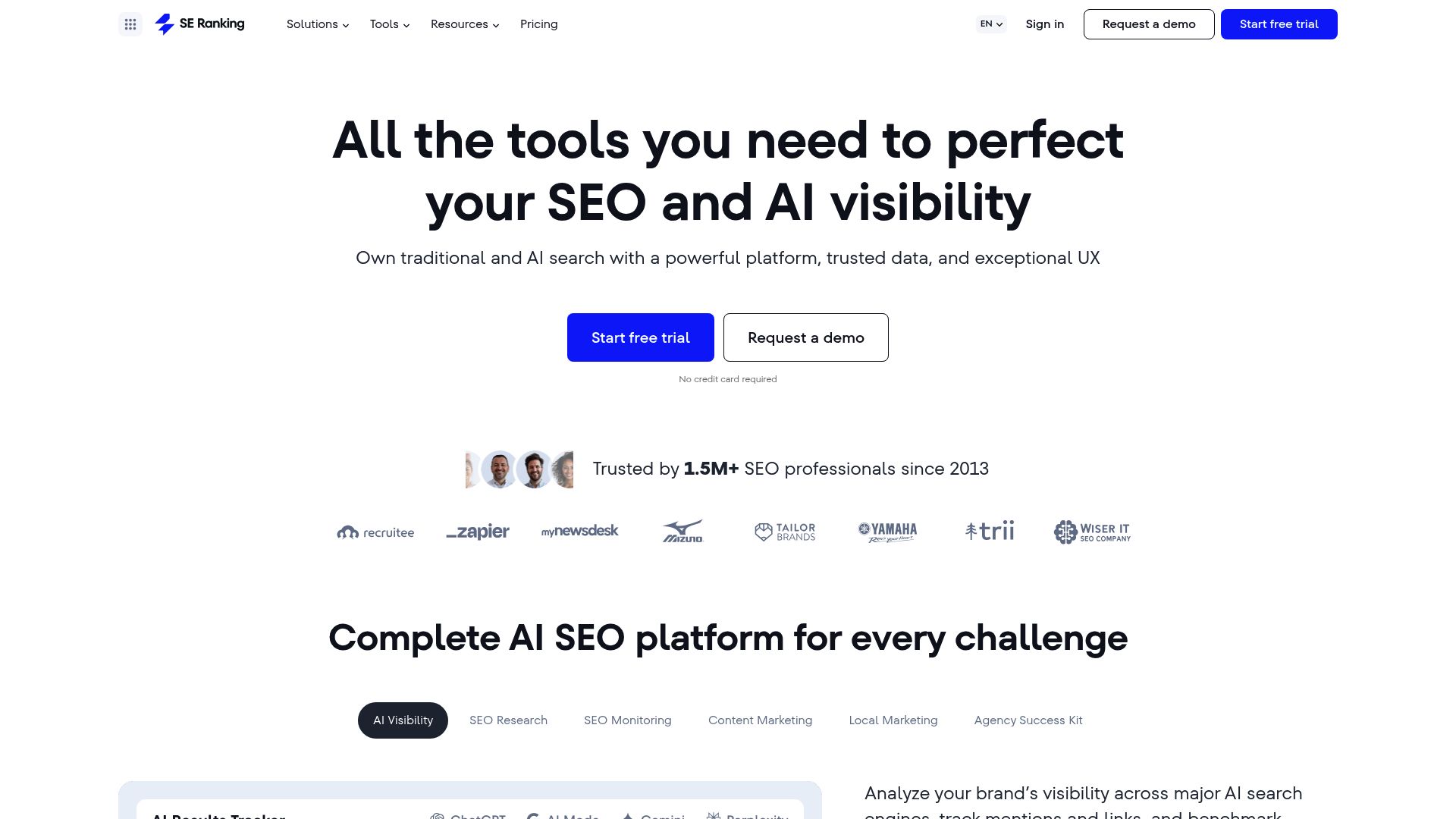
But the real magic is in the daily automated updates. Every single day, SE Ranking is checking your keyword positions on different devices and in different locations. This is huge if you're an international business.
I mean, what good is ranking #1 in London if you're nonexistent in New York?
Here are some of its best automation perks:
- Daily ranking updates: You wake up to fresh data every morning, along with trend analysis that helps you see the bigger picture over time.
- Automated email alerts: Forget logging in just to check for disasters. The system will email you right away if there's a big shift in your rankings.
- Workflow integration: It plays nice with keyword discovery tools, so if you notice a rank slipping, you can jump straight into research mode without missing a beat.
- Technical recommendations: It'll even point out technical tweaks you can make to your site that might give your rankings a little bump.
And what about the price?
It's actually pretty affordable. With plans starting around $99 a month, it's a solid fit for growing businesses that want big-league data without the crazy price tag.
When it comes to accuracy and automation, it's a real powerhouse.
2. Ahrefs Rank Tracker
If you've spent any time in the SEO world, you've definitely heard of Ahrefs.
They're a giant in the SEO space.
And while most people know them for their insane backlink data, their Rank Tracker is easily one of the strongest automation tools you can get. Ahrefs shines when you need to watch your competitors as closely as you watch yourself.
It allows for comprehensive tracking that goes beyond simple positioning. You can monitor your keyword positions across Google for multiple devices and locations simultaneously.
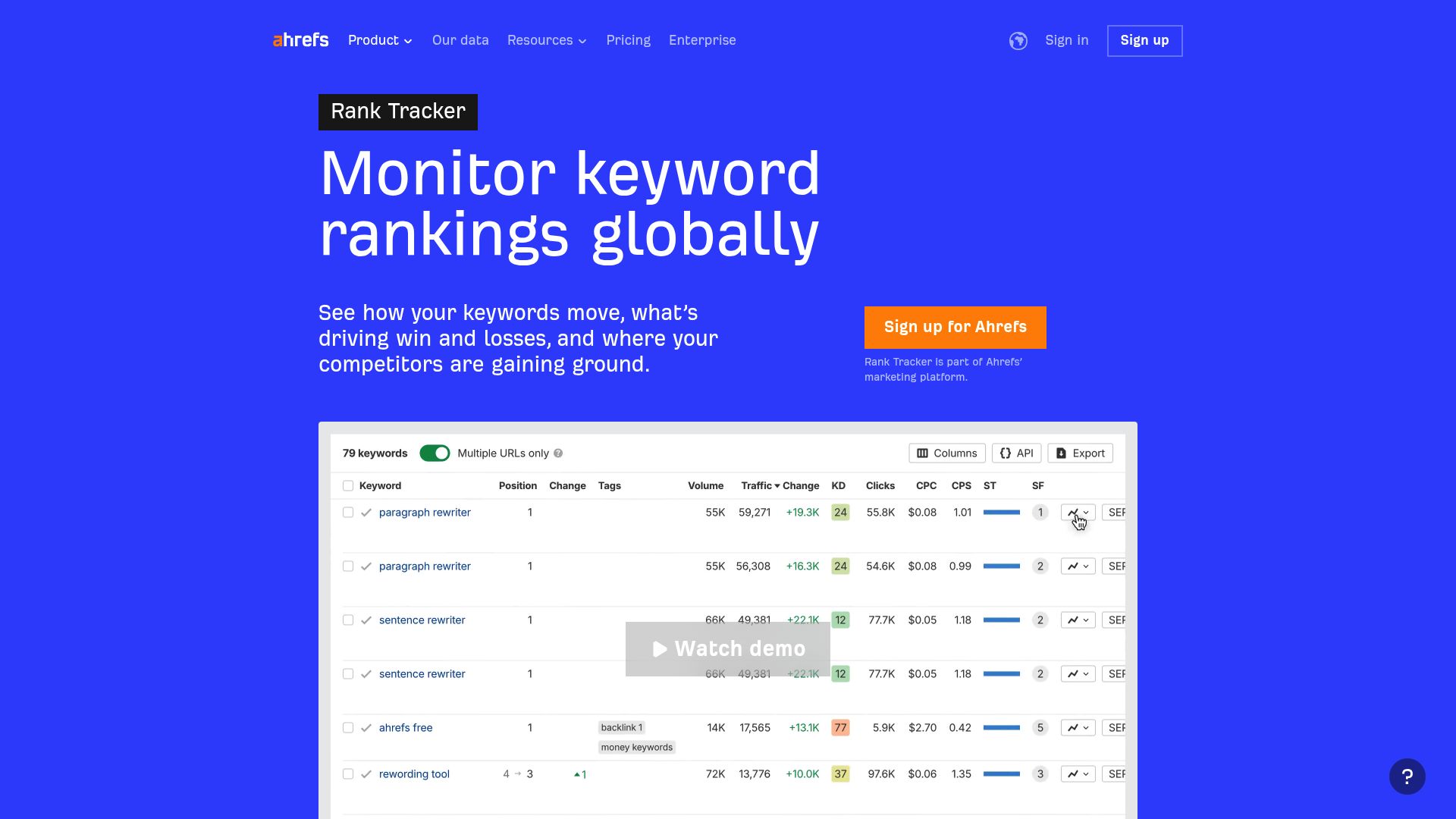
The special sauce with Ahrefs is all the context you get.
It doesn't just say you rank #5.
It tells you how difficult it would be to get to #1 based on the backlink profiles of the sites above you.
Some of its key automation features are:
- Competitor spyware: It automatically keeps tabs on your competitors' keywords every single day. You'll know the exact moment they pull ahead of you.
- Historical data: The tool saves a ton of old performance data, letting you spot those big, long-term shifts in your industry.
- Ecosystem integration: Everything works together with their site audit and backlink tools, which is a massive help for figuring out why a rank actually changed.
- Comparison reports: It can automatically generate reports showing you exactly how you measure up against as many as 10 competitors, all in one place.
The price tag reflects how powerful it is, starting at $129 per month.
Yeah, it's a bit more than some others, but most agencies feel the insane depth of competitor data makes it a must-have. It's definitely positioned as a top-tier tool for serious SEO pros.
3. SERPWatcher by Mangools
But let's be real, sometimes you don't need a Swiss Army knife.
Sometimes, all you need is one really, really sharp knife. That's SERPWatcher from Mangools in a nutshell. Their whole game is about being easy to use and having a great user experience.
If you've ever felt overwhelmed by tools like Ahrefs, SERPWatcher will feel like a breath of fresh air.
It automates all the keyword rank tracking but presents the information in a really visual way. It means you can see how you're doing in seconds, not hours.
Where this tool really makes a name for itself is with its automated alerts and SERP monitoring features. It keeps an eye on your rankings for specific locations and devices, so you can be sure your local SEO efforts are actually paying off.
Check out some of its cool automation features:
- Visual daily updates: The dashboard has a neat "Dominance Index" that gives you a quick snapshot of your overall market share.
- Smart alerts: It sends you an automated email the moment it detects a sudden rank change, letting you react quickly to things like Google algorithm updates.
- KWFinder integration: It links up with their KWFinder tool, which smoothly connects the dots from finding a keyword to tracking its performance.
- Interactive reports: You can send automated, interactive reports to clients or team members.
One of the biggest selling points is the barrier to entry. They offer a free tier to start, with paid options that are very affordable for mid-range budgets. If you are just starting your automation journey, this is often the most logical first step among the 4 Automated Tools for Keyword Rank Tracking Automation.
4. Semrush Rank Tracker
Semrush is the other behemoth in the SEO world, right up there with Ahrefs. It tends to be the favorite for in-house marketers who are looking for that one single platform to do pretty much everything. Their rank tracker is just one piece of a much larger puzzle, because Semrush builds its tracking directly into a massive all-in-one marketing suite.
What that means is your ranking data is connected to everything else, your social media efforts, your content marketing, even your paid ads. Basically, it helps you connect all the dots.
The tool provides automated daily updates and really shines when you want to dig into historical trends.
If your team is already using a bunch of different marketing tools, Semrush can make a ton of sense.
Some standout automation features include:
- Holistic tracking: It keeps an eye on your daily keyword positions automatically and even has a feature to detect high volatility.
- Cannibalization reports: It'll automatically tell you if you're accidentally making two of your own pages fight for the same keyword.
- Sensor data: They have a "SERP Sensor" feature that keeps tabs on how much Google's results are shaking up, so you can tell if a ranking drop was your fault or just a massive algorithm update.
- Deep integration: It plugs into more than 50 other tools right inside the Semrush dashboard, bringing all your automation under one roof.
The Professional plan kicks off at $129.95 per month.
It's definitely an investment, there's no doubt. But for teams that want to automate more than just their SEO (like PPC and social media), it rolls several different tool costs into a single bill.
Strategic Considerations for Automation
Picking the right tool is a big deal, but knowing how to use it properly is where the real magic happens. We see this mistake all the time: businesses get totally obsessed with high-volume keywords that end up bringing in zero actual revenue.
When you're picking an automated rank tracking tool, your focus really needs to be on Search Intent, not just raw search volume. Think about it: a keyword with 10,000 monthly searches could send you 10,000 people who take one look at your page and leave instantly. Meanwhile, a keyword with only 100 searches could land you 10 paying customers.
This is why automated tools need to give you more than just raw numbers. You should be looking for tools that offer click-through rate (CTR) analysis, because some search terms are known to have a "Low CTR by Query."
This is usually because Google just gives the answer right there on the results page, leading to what we call "Zero-Click searches." Hitting #1 for one of those keywords feels good, but it's often just a vanity metric that does absolutely nothing for your bank account. Update frequency is another huge deal.
Thankfully, all four tools we've mentioned here offer daily updates. Let's be real, in the world of SEO, things change so fast that weekly updates just don't cut it anymore.
You need daily data to catch technical hiccups or even negative SEO attacks before they can wreck your traffic.

Justin Ziadeh / Unsplash
Geolocation is also non-negotiable. If you are selling globally, you need a tool that supports mobile index tracking across different countries. What works in Berlin might fail in Tokyo.
Automation allows you to scale this monitoring without hiring local teams in every market.
Your Path to Automated Dominance
We have explored the 4 Automated Tools for Keyword Rank Tracking Automation. They are the eyes and ears of your operation. Systems like SE Ranking and Ahrefs give you the clarity needed to make decisions.
However, clarity without capacity leads to frustration. You might see the opportunity, but do you have the time to write 3,000 words today?
Do you have the network to secure 5 high-authority backlinks this week?
This is where RobotSpeed transforms your business. We take the insights that these trackers provide and turn them into published assets. Our AI agent researches, writes, and optimizes content that bypasses AI detection.
We build the backlinks that boost your domain authority.
If you are ready to stop just watching your rankings and start actually influencing them, it is time to upgrade your stack. You can automate the entire lifecycle of SEO, from the initial keyword spark to the final conversion.
Don't let your competitors outwork you while you are busy analyzing data. Let the robots handle the speed so you can handle the strategy.
Visit our AI Content Agent services to see how we can accelerate your growth 40x faster than manual methods.
FAQ
Why is daily rank tracking important?
With daily tracking, you can catch those sudden ranking drops the moment they happen, letting you figure out if it's a technical glitch or a penalty before your whole month's traffic goes down the drain.
Can these tools track local SEO rankings?
Absolutely.
All the tools we've talked about, SE Ranking, Ahrefs, SERPWatcher, and Semrush, have geolocation features built in. That means you can see exactly how you're ranking in specific cities or countries, which is a game-changer for any local business.
Is automated content creation safe for SEO?
That really comes down to quality.
You can definitely get dinged for pumping out generic AI spam. But tools like ours at RobotSpeed are different, we use an AI agent that properly researches topics to write high-quality, genuinely helpful content that sounds human, sails past AI detectors, and gives readers (and Google) exactly what they want.
How much should I spend on SEO tools?
For a mid-sized business, you can typically expect to budget somewhere between $99 and $200 a month just for good tracking tools.
But don't forget, that's just for tracking. You also have to think about what it costs to actually create content and build links, which is why an all-in-one automation service often gives you a much better return on your investment.