
If you think top-tier SEO requires a massive budget, you're not alone.
But honestly, that's a huge misconception. We talk to business owners every single day who think they have to shell out thousands a month just to get started with artificial intelligence.
The reality is quite different.
While premium automation, like what we do here at RobotSpeed, offers speed and convenience, you can actually piece together a powerful strategy using free ai seo tools. If you have more time than money right now, digging into these zero-cost solutions is a brilliant move.
You don't need a huge budget to leverage AI. We have dug deep into the research to bring you tangible solutions.

So, we’ve put together a list of 5 genuinely free AI SEO tools you can fire up today to start improving your content and rankings.
And these aren't just flimsy trials, we're talking about solid tools that deliver real value without costing you a dime.
Why Free AI SEO Tools Are Essential for Mid-Budget Businesses
Let's be real for a second.
The whole digital world has changed like crazy in the last year and a half. It's not just about keywords anymore, it’s about understanding intent, context, and being fast.
And AI has really leveled the playing field. If you're running an international business or a growing agency, you need to be able to test the waters without getting locked into a massive contract.
That's where free AI SEO tools come in.
They let you validate a strategy, you can actually prove to yourself that AI detectors are a big deal or that automated keyword clustering works, all before you even think about pulling out a credit card.
The tools we are about to discuss fit a specific profile.
They are credible, widely used, and perfect for businesses with budgets in the $99+/month range who might eventually look for more integrated automation but need immediate, low-cost wins right now.
It’s about working smarter, not just harder. By integrating these tools, you save hours on manual research and drafting. That is time you can put back into your product or client relationships.
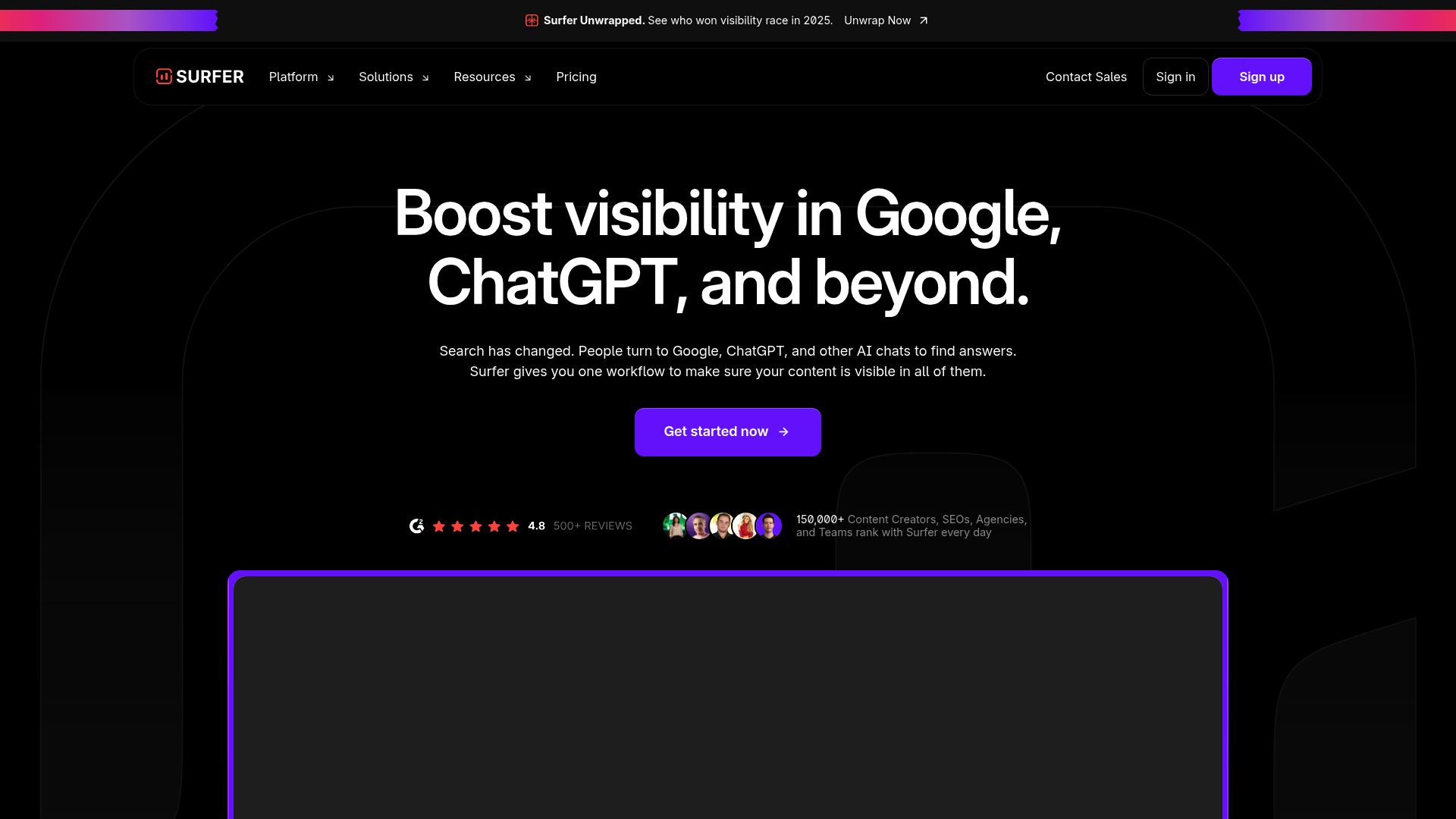
1. Surfer, Free AI Content Utilities for On‑Page SEO
Surfer’s a huge name in the SEO world, and for good reason.
You probably know them for their paid content editor, but what’s surprising is how much value they give away for free.
It's a go-to on-page SEO platform for a ton of agencies and in-house teams. Now, here's where it gets interesting.
Even without a paid plan, you can access some of their AI tools for free, and they’re incredibly helpful for beefing up your content strategy.
Unlocking the Power of the AI Content Detector
They get that people need to trust your content before they'll ever engage with it. And let's be honest, one of the biggest fears for any business today is getting hit with the dreaded "spam" label.
Sure, Google says they care about high-quality content no matter how you make it, but your readers' trust?
That's a different story, and it can be pretty fragile.
Surfer has a tool that flags whether your content sounds "AI-written," which gives you a chance to tweak the tone and structure to avoid losing your audience's trust or seeing engagement drop.
After all, you don't want your blog to read like it was spat out by a robot with zero human touch.
You know those drafts that have all the right facts but just... no soul? Source: MarketerMilk
The AI Content Humanizer
It just feels stiff.
That’s exactly where their Humanizer tool steps in.
It takes AI-generated text and reworks it to sound more natural and a lot less repetitive, which is a lifesaver for keeping your brand voice consistent.
If you're running a lifestyle brand or any kind of service business, you already know that genuine, empathetic language converts way better than a list of dry facts.
Using these free tools is a great way to support your bigger AI content optimization workflow. Source: MarketerMilk
Why this matters for your workflow
And if you decide to upgrade later, you get access to their full Surfer AI suite, content scoring, and even AI visibility tracking.
But just to get started?
These free tools are more than enough to polish your drafts. There's good evidence that tweaking your content with these tools can make a real difference in how readable it is.
Trustworthy sources back this up, running these checks helps you dodge penalties that come with low-quality, spammy-sounding content.
Ideal User Profile
- Any business using AI to help with content that's worried about quality, tone, and keeping their readers' trust.
- Teams that might later invest in full Surfer plans but need to validate the technology first.
2. Gumloop, Free AI Workflow Builder for SEO Automation
If you enjoy tinkering with logic and data, you are going to love Gumloop. It represents a different side of free ai seo tools.
It isn't just about text; it is about infrastructure.
Gumloop allows you to build AI agents and workflows that can automate repetitive SEO tasks. We're talking about being able to pull data, summarize what you find, and even draft parts of your content without having to write a single line of code.
Building Your First Agent
Think about this: you probably check your competitors' rankings every Monday morning, right?
It's tedious, boring work. With Gumloop, though, you can build your very first AI agent, for free, to take care of that exact task.
Its drag-and-drop interface makes it super easy to use.
You can literally tell an agent: "Go to this URL, grab the headers, and give me a summary of the topic."
This capability transforms how small teams operate. Source: MarketerMilk
Data Integration Power
The real magic happens when you connect external data.
You can connect Google Analytics and even use Semrush data inside Gumloop to create automated workflows combining real data with update Large Language Models (LLMs).
Think about the implications. You could automatically pull keyword and traffic data, then generate weekly opportunity summaries. This thing turns raw data into useful insights in a flash.
Imagine turning your Search Console exports into a prioritized "to-do" list for content refreshes, all on autopilot. Source: MarketerMilk

Ideal User Profile
- Marketing teams who want to actually put AI to work, not just chat with a bot.
- Agencies that could save a ton of billable hours by creating reusable AI workflows for different clients.
Speaking of smart data integration, this reminds me of how the e-commerce world handles logistics. Just as logistics companies are obsessed with optimizing routes to save fuel and time, you should be just as obsessed with optimizing your data flow.
For instance, just look at how strategies in Swiss e-commerce transport rely heavily on tight tracking and precision. If an online store is automating its shipping logistics, it absolutely makes sense to use a tool like Gumloop to automate its traffic analysis, too.
3. Google Keyword Planner, Free AI‑Enhanced Keyword & Value Insights
I know what you might be thinking: "Wait, Google Keyword Planner isn't an AI tool."
But that's where you'd be wrong, it has evolved. People often think of it as just a PPC tool, but the Keyword Planner is still one of the most solid sources for free keyword data out there. Source: MarketerMilk
The AI Angle You Missed
Google increasingly uses machine learning in how it clusters, expands, and estimates keyword performance in the planner. It’s plugged directly into Google’s own data for search volume and uses some pretty heavy-duty machine learning for its predictions.
It helps you find semantic variations you would never think of manually. This is the foundation of a good topic cluster. Source: TheCMO
Using CPC as a Value Metric
Here's a strategy we love at RobotSpeed. Here's a pro tip: use the CPC (cost-per-click) data as a shortcut to figure out a keyword's *value*. Think about it: if advertisers are willing to pay $10 for a single click, you know that term has serious commercial intent.
A higher CPC almost always means more value. This lets you dig into keyword volumes and competition so you can prioritize what's actually going to make you money, not just chase vanity traffic.
This lets you line up your content calendar with what actually drives revenue.
Ideal User Profile
- Any business that needs to figure out which topics are actually worth spending content budget on.
- Teams who are already comfortable in the Google Ads world and want access to first-party search data without paying a cent.
4. ProductRank.ai, Free AI Search & LLM Visibility Tracker
We're stepping into a completely new era.
It's being called GEO: Generative Engine Optimization. With the rise of AI search (think ChatGPT, Claude, Perplexity, and others),
it's not enough to just rank on Google anymore. You've got to show up in the AI's answers, too. That's exactly what ProductRank.ai does, it tracks how your brand is mentioned in these LLMs and AI search engines.
Why it matters for 2024 and beyond
Your old-school rank trackers are completely blind to what's happening in ChatGPT.
You can be sitting pretty at number one on Google, but what if someone asks ChatGPT "Who has the best X?"
you're losing market share right there. ProductRank.ai lets you peek in and see how your site is performing for specific questions and keywords inside ChatGPT, Claude, and AI search tools like Perplexity.
Trust me, this is the next big battleground.
Identifying the Gap
You can use this tool to figure out which questions and search intents bring up your brand versus your competitors in these new AI interfaces.
If you spot a pattern where AI tools are quoting your competitors more than you, you've just found a major content gap.
That's your cue to create deeper, more authoritative content on those topics so the LLMs start referencing you instead.
It’s how you’ll stay relevant as the way people search continues to change.
Ideal User Profile
- Brands that are already doing well on Google and want to defend their spot (and grow) in the new world of AI search.
- International businesses that need to keep an eye on how AI assistants are talking about them in different markets.
5. AirOps, Free Plan for AI‑Driven SEO Workflows & Content Ops
Let's face it: scaling content is tough.
And maintaining quality while you do it?
Even tougher. AirOps bills itself as an "AI operations layer" for marketing and SEO.
It is used to automate research, content creation, and reporting using flexible workflows. The goal is to move from "random acts of content" to a systematic production line. Source: Whatagraph
Standardizing Your Output
On their free starter plan, you can test AI workflows that change the game.
We are talking about creating content briefs and outlines driven by SERP data or generating drafts for SEO landing pages.
You can even go as far as building your own internal tools, like a "content gap analyzer" that works based on your specific rules.
And that kind of consistency is everything for SEO success. Source: Whatagraph
Combining AI with Hard Data
But its best feature, hands down, is how it lets you mix AI with hard SEO data from tools like Google Search Console or other APIs.
This creates a standard process for how your team researches and creates content at scale. So, instead of every writer just doing their own thing, everybody is on the same page, following the same high-quality AI workflow.
Having solid project management is a must here.
It actually reminds me of how a lot of physical industries tackle complex jobs.
For instance, take high-end woodworking, for example, the follow-up of custom projects requires a sharp eye for detail, strict timelines, and constant quality checks. AirOps feels like it brings that same disciplined approach to your digital content assembly line.
Ideal User Profile
- Teams with a modest budget who are ready to standardize and scale up their AI-powered SEO work.
- Agencies that are desperate for repeatable, template-based workflows they can use for client after client.
How a Mid‑Budget Business Can Use All 5 Together
Staring at this list, you might be feeling a little overwhelmed.

α Oinam / Unsplash
Five different tools?
It sounds like a whole lot of browser tabs and login screens. But look, for an international company already spending around $99/month on SEO and AI, building a smart "free-first" toolkit like this is an incredibly powerful move.
Step 1: Research & Prioritization
Here’s how you can actually weave them all together into a smart strategy: Kick off your week in Google Keyword Planner.
Look for high-volume terms with high CPC. This tells you what to write about to make money.
Group them into clusters using the suggestions provided.
Step 2: AI Search Visibility Check
Before you write, check ProductRank.ai. Are you missing from the AI conversation on these topics?
If yes, note that you need to be very fact-heavy and authoritative in your upcoming content to get cited.
Step 3: Ops & Automation
Use Gumloop to automate the data pull.
Have it pull the top 10 results for your target keyword and give you a quick summary of the headings they're all using. From there, you can pop that data into AirOps to spit out a standardized content brief for your writing team.
Step 4: Creation & Optimization
Once you have a draft, whether it's from a human or an AI, run it through Surfer’s free AI tools.
Humanize the text a bit, check it for any AI detection flags, and just make sure it reads well. This simple workflow creates a solid engine for growth, all without racking up a huge monthly bill.
The RobotSpeed Advantage
While the strategy above is powerful, it has one major flaw: it is fragmented. You have to switch tabs, move data manually, and manage five different logins.
This is where RobotSpeed changes the equation. We put the entire SEO content process, from topic research and writing all the way to publishing and backlink building, on autopilot.
Instead of piecing together free tools, our AI Content Agent handles the research, writing, and optimization in one flow. We include the Competitor Analysis and a Premium Link Network directly in the subscription.
Think about it. We deliver results 40x faster than manual SEO efforts because we integrated every step. You get the power of all five tools listed above, plus automated publishing to WordPress or Shopify, under one roof.
If you are ready to stop juggling tools and start dominating rankings, it might be time to look at our all-in-one solution.
Frequently Asked Questions
Are these free AI SEO tools really free?
Yep, the tools we’ve listed work on a "freemium" model. They offer a ton of value, like Surfer's AI detectors or Google's keyword data, completely free, but they keep their more advanced, high-volume features for paying customers. For a lot of mid-sized businesses, the free versions are more than enough to get you started.
Can I rank on Google using only free AI tools?
You absolutely can. Google couldn't care less about how much you paid for your software; it ranks content based on quality, relevance, and authority.
The only catch is that free tools usually mean more manual work and juggling to connect all the dots, which is where an all-in-one automated solution like RobotSpeed comes in.
Is AI-generated content bad for SEO?
Not on its own, no. Google has been pretty clear that they reward great content, no matter how it’s made.
The real danger is in publishing raw, unedited, low-quality AI content that doesn't help anyone.
Taking the time to "humanize" and fact-check your AI drafts is a critical step for any long-term success.
How often should I use Gumloop or AirOps?
We'd suggest getting some weekly workflows set up.
Remember, SEO is a marathon, not a sprint. Automating things like a weekly report or the creation of content briefs helps you stay consistent, and consistency is probably the single most important factor in search rankings.
Ready to Automate Your Growth?
You’ve now got the playbook for using these free ai seo tools. Now it is time to execute. Whether you build your own stack or choose a streamlined partner like RobotSpeed, the future of search is automated.
Don't let your competitors own the AI space. Start your analysis today, and if you want to see how fast you can really go, check out our Premium Link Network and Content Agent.