
Let's be honest, trying to rank on Google right now can feel like a classic David versus Goliath story.
You've probably seen it—big corporations hogging the top spot for just about every keyword you're after.

They've got huge teams, budgets that seem bottomless, and a brand name that practically guarantees clicks.
However, the landscape is shifting rapidly due to automation. This is exactly where RobotSpeed for small business SEO enters the conversation. It creates a legitimate shortcut for companies that cannot afford a five-figure agency retainer but still need aggressive growth.
The data is clear: businesses get traction way faster when they go after long-tail keywords that solve very specific problems.
But here's the catch: most small teams just don't have the 40+ hours a month it takes to do all that work by hand.
And you shouldn't have to pick between actually running your business and getting seen on Google.
We built it to help small and mid-sized businesses pull in more organic traffic without all the mind-numbing manual work.
If you are tired of seeing your competitors rank while you stay on page two, this guide is for you.
1. What RobotSpeed Is (and Where It Fits in Your Stack)
Let's clarify what we are talking about here. There is a lot of noise in the martech space.
RobotSpeed isn't just a keyword tool, nor is it merely a text generator.
Based on its feature positioning, the platform acts as a hybrid.
It’s an automated SEO agent that handles research, writing, and technical distribution.
Imagine having a tool that’s part Semrush-lite and part Jasper-style AI writer, but it’s completely focused on getting you results in search engines, not just writing pretty sentences.
Its job is simple, but it's absolutely critical: automating all those time-sucking tasks like keyword research, on-page tweaks, and building internal links.
This means you can ramp up your content production without needing to hire a full team. For businesses working with a budget around $99 a month, it hits the perfect sweet spot.
You definitely still need strategy and oversight. No tool is a magic wand. But RobotSpeed’s value lies in saving you dozens of hours by surfacing clear "do this next" tasks rather than raw data spreadsheets.
📸 semrush.com
2. Strategic Goals for a Small Business Using RobotSpeed
Using RobotSpeed for small business SEO requires a shift in mindset. You cannot play the same game as Amazon or Wikipedia.
Your primary goal should be winning lower-competition keywords. These are the "long-tail" queries that signal high intent. While big brands fight over broad terms like "shoes," you can dominate terms like "best orthopedic running shoes for flat feet."
Studies keep showing that small businesses get results much faster by zeroing in on these kinds of problem-solving search terms.
And with automation, you can actually find these hidden gems at scale. Your next move? You've got to aim to publish more high-quality, optimized content each month than your direct competitors.
Let's face it, consistency is the toughest part of SEO. When you pair AI with a real human editor, though, you can keep a publishing schedule that would normally take a team of three writers to manage.
Another major goal is technical health.
You need to fix technical and on-page issues in batches so Google can crawl and trust your site faster. Google's own documentation emphasizes that crawlability is the foundation of all rankings.
By systematizing SEO into weekly workflows, you stop treating it as an emergency task and start treating it as a growth engine.
3. Set Up: Foundations Before You Turn on Automation
Before you let the robots take over, you need to ensure your house is in order. Automation amplifies what is already there, good or bad.
First, verify that you have Google Search Console and Analytics installed. These are your sources of truth.
Without them, you are flying blind regarding performance measurement.
Next, look at your website's performance. A fast, mobile-friendly website is non-negotiable today. Google emphasizes page experience heavily.
If your site takes ten seconds to load, no amount of AI content will save you.
If you're in a field like auto or tech, you already know the engine is way more important than the paint job.
Think about it: just like you'd tune a car for peak performance, your website needs a rock-solid technical engine to run well.
A site like techcar.ch gets it—high-performance tech, whether it’s in a car or a website, needs that expert fine-tuning to handle speed.
Your site's layout needs to be crystal clear, too.
A good rule of thumb is to stick to one main topic per page and use a URL structure that makes sense.
A clear site structure helps search engines understand exactly what you sell.
Finally, if you serve local markets, ensure your Google Business Profile is active and verified. Automation tools can help monitor this, but the initial verification is on you.
4. Using RobotSpeed for Keyword & Topic Strategy
This is where the magic happens. Strategy is usually the hardest part for small teams.
4.1. Lean into long-tail, purchase-intent queries
You need to stop guessing what your customers type into Google. Use RobotSpeed for small business SEO to uncover the data.
Start by seeding topics with your main service or product. Let the tool spit out question-based keywords (think "how to...") and comparison terms (like "X vs Y pricing").
Filter these results aggressively. Look for moderate to low difficulty scores combined with clear buyer intent.
Ask yourself: does this search term sound like someone's ready to pull out their wallet, or are they just kicking tires for free info?
If you're an international small business, you'll want to prioritize searches like “Best service for [specific audience]” or “pricing for startups.”
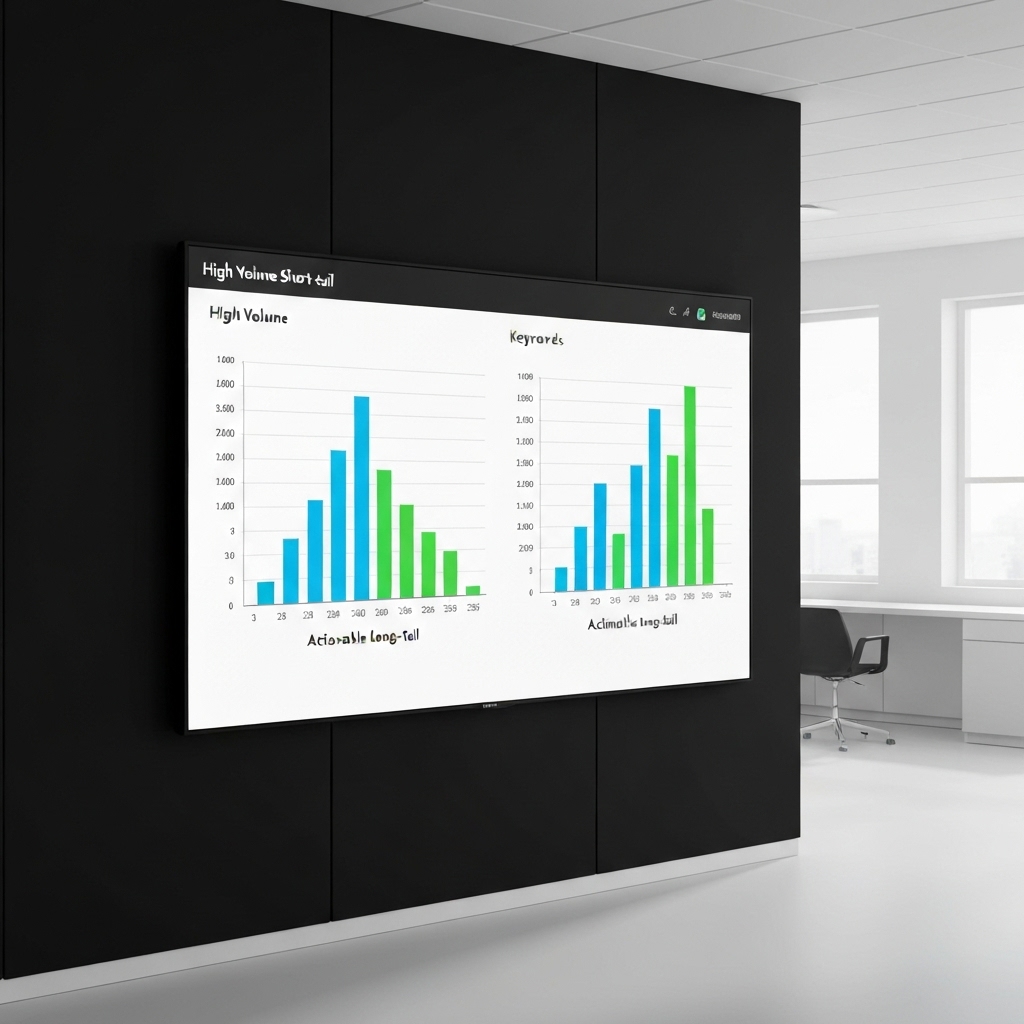
These are what we call 'money terms.' Your goal should be to build a master list of 30 to 60 of these high-value keywords. RobotSpeed’s automation features generally allow you to cluster related terms into content hubs. This prevents you from writing five articles about the exact same thing, which hurts your rankings.
By grouping these keywords, the tool can suggest which page to build first based on a mix of volume and your site's current authority. It takes the guesswork out of your content calendar.
5. On-Page Optimization with RobotSpeed
Most small businesses leave easy wins on the table.
We see this constantly.
Title tags, meta descriptions, correct header usage, and internal links are often neglected. Yet, optimizing these elements provides some of the fastest ROI in SEO.
You should use RobotSpeed to audit and bulk-suggest improvements. Start with your Title tags and H1s.
They must include the primary keyword, a clear benefit, and your brand name where appropriate.
Automation tools can even propose variants for you to A/B test. For instance, just testing a title like "SEO Tools" against "SEO Tools for Small Business | Save Time" could give you wildly different click-through rates.
And don't sleep on internal linking—this is where automation is incredibly powerful. We've seen from tools like Botify that automating internal links at scale makes a huge difference in how efficiently Google can crawl a site.
RobotSpeed can actually point out opportunities to link from your older, high-authority posts to your new articles, spreading the SEO love.
Think about a business in the rental space. A company like Propyloc, for example, is juggling inventory for all sorts of different equipment.
Making sure their "excavator rentals" page links over to "construction tools" is absolutely crucial for helping customers find what they're looking for.
Think of your internal links as a roadmap for both Google and your real-life customers.
Also, make sure your headers (your H2s and H3s) are actually answering all the little sub-questions that pop up around a topic. Use the content analyzer to highlight missing subtopics that your competitors are covering but you are not.
6. AI-Assisted Content Production (Where RobotSpeed Shines)
Here is the controversial part: AI content. Many get this wrong by letting the AI run wild.
6.1. Workflow: Human strategy + AI draft + human edit
Evidence suggests the most effective pattern is using AI for first drafts followed by human editing.
But please, don't just set it to 'auto-publish' and walk away. You need a human in the loop. The first step is to generate an SEO brief.
Just pop your target keyword into RobotSpeed, and it will give you suggested headings, common questions people ask, and related terms to include.
This makes sure you're covering the topic from all angles, which is exactly what Google's own best practices recommend for creating helpful content.
From there, you can use the "SEO article" templates to get a first draft going. This works great for those big 2,000-word pillar pages or even just shorter, supporting blog posts.
Then comes the most important step: the editorial pass.
You—or a copy editor—must verify facts. AI can hallucinate.
You need to add concrete examples, case studies, and your unique point of view.

Alex Lakas / Unsplash
This human touch creates the "experience" part of Google's E-E-A-T guidelines. It differentiates you from the spam.
6.2. Publishing cadence for your budget
With a mid-range budget of around $99/month, using RobotSpeed for small business SEO really helps you keep up a serious publishing pace.
A realistic goal for an international SMB is to publish two to four high-quality blog posts a month with a little help from AI.
On top of that, try to refresh one of your core service pages each month, and maybe create one or two "lead magnet" guides per quarter.
RobotSpeed’s automation reduces the drafting time by roughly 80%, allowing you to hit this cadence without burning out or hiring a massive team.
7. Technical & Automation: Getting Google to Trust and Crawl You Efficiently
Technical SEO sounds scary, but automation simplifies it. You do not need to be a coder.
Enterprise platforms often demonstrate that automating technical optimizations leads to large gains. RobotSpeed brings this power to the small business level.
Use the tool to automate technical checks. It will detect broken links, missing meta tags, and duplicate titles. Instead of a confusing list of errors, you get prioritized fixes.
You should also monitor Core Web Vitals. While speed is crucial, you simply need to know if your templates are slowing you down. Use the recommendations to compress images or remove heavy scripts.
Structured data is another area where automation wins. Generating schema for FAQs, how-tos, and local businesses can enhance how much real estate you take up on the search results page.
Finally, automate your routine reporting. You don't want to spend hours in spreadsheets.
Consolidate your rankings and traffic data into simple dashboards via RobotSpeed so you can make quick decisions.
8. Local & International: Balancing Both with RobotSpeed
What if you sell globally but also have a local presence?
It’s a challenge a lot of businesses face. For your Local SEO, you'll want to stick to the classic playbook: make sure your location-specific pages are buttoned up and optimized.
This is where automation comes in handy, helping you create localized versions of your content for different cities without getting flagged for duplicate content.
Take a coaching business, for instance. They have to build a deep, trusting connection with their local clients.
A site like Timeless Coaching is a great example—they get that they need local content that speaks to the specific needs of their community (like fitness in Crissier).
RobotSpeed makes it possible to scale up this content creation, so you can actually have unique pages for every single city you serve.
And for International SEO, you can use AI to create localized versions of your content—and I'm talking about more than just a simple translation.
You have to tweak things like examples, currencies, and cultural references, because Google has made it clear that they want to see a distinct site structure for international audiences.
Make sure your site is using subfolders or subdomains in a way that clearly tells search engines which version of your site is for which country.
9. Measuring ROI and Deciding Where to Spend Human vs. Tool Budget
How do you know if RobotSpeed for small business SEO is actually making money?
9.1. Metrics to track monthly
You need to look beyond vanity metrics.
Focus on organic sessions and new users. Keep an eye on your non-branded keyword rankings. That's where you'll see true growth, not just from people who already know you.
But above all, you have to track conversions.
Are people filling out forms or booking demos?
Measuring actionable results is the only way to justify the SEO investment.
You should aim for a 3 to 6-month timeline to see consistent ranking climbs for long-tail terms.
SEO is a marathon, not a sprint.

Logan Voss / Unsplash
9.2. When RobotSpeed vs. agency vs. in-house
Deciding where to put your dollars is tough. Given your mid-range budget, RobotSpeed is best for owners or marketers willing to be hands-on weekly.
An agency is useful for massive technical overhauls or high-stakes link building if you have the extra budget.
An in-house hire makes sense once organic search is a proven revenue channel for you.
Industry analysis confirms that automated platforms don't replace pros, but they free them up to focus on strategy.
Think of RobotSpeed as a force multiplier for your small team.
10. A Practical 90-Day RobotSpeed SEO Plan
Let's get practical.
Here is exactly what you should do to launch RobotSpeed for small business SEO effectively.
Weeks 1–2: The Cleanup
Connect your site, Search Console, and Analytics to the platform.
Run a full site audit immediately. You need to fix critical technical errors like 404s and redirects first. Then, define your 30-60 keyword topic set using the research tools.
Weeks 3–6: The Build
Start publishing. specific Aim for two or three AI-assisted blog posts targeting those long-tail terms we discussed. Also, improve one core service page.
Implement internal linking suggestions across your top 20 existing pages to spread authority.
Weeks 7–12: The Scale
Continue your publishing cadence. Add FAQ or comparison pages around your main offerings. Expand your structured data usage and refine page speed based on the tool's feedback.
Start tracking your non-branded rankings as your primary KPI.
Executed consistently, this plan allows a small business to compete with larger players. It focuses your limited time on what matters: content depth and technical health.
Wrapping Up
The gap between small businesses and enterprise giants is closing, thanks to AI.
You no longer need a ten-person team to execute a comprehensive SEO strategy.
With tools like RobotSpeed, you can automate the research, drafting, and technical monitoring that used to take weeks.
The key is consistency and strategic oversight. Use automation to handle the heavy lifting, but keep your human insight at the helm for quality control.
Ready to stop playing catch-up?
Start your RobotSpeed trial today and see how much faster you can rank.
FAQ
Does RobotSpeed replace a human SEO expert completely?
No, it acts as an assistant.
It handles repetitive tasks and drafts content, but you still need a human to set strategy and review the final output for brand voice.
How fast will I see results using RobotSpeed for small business SEO?
Typically, businesses see traction on long-tail keywords within 3 to 6 months of consistent use, provided the content quality is high and technical issues are resolved.
Is AI content penalized by Google?
Nope.
Google's focus is on rewarding high-quality content, no matter how it was made.
The trick is to make sure you're editing any AI drafts to add your own unique value, check for accuracy, and make sure it's genuinely helpful for the reader.
Can I use RobotSpeed for an e-commerce store?
Absolutely.
It's especially great for generating unique product descriptions and optimizing category pages—two of the biggest headaches in e-commerce SEO.