
An ai checker detects whether content was written by AI or a human, a critical verification step as generative tools flood the web with machine-generated text. These detection tools analyze linguistic patterns, sentence structure, and word predictability to flag AI-written material that could harm your SEO rankings or brand credibility.
At RobotSpeed, we use AI-powered content automation daily, which is why we understand verification matters. Google's algorithms increasingly penalize low-quality AI spam, making detection essential for any business publishing at scale. The question isn't whether to use AI, it's how to use it transparently while maintaining quality standards.
We tested the market's leading solutions and identified the 7 best ai checker tools for 2026, drawing from in-depth analyses by Detecting-AI, Selzy, and Zapier. Here's what separates the accurate detectors from the unreliable ones:
- Detection accuracy across GPT-4, Claude 3.5, and Gemini models
- False positive rates with human-written content
- Pricing transparency and free trial availability
- Batch processing for agencies handling multiple clients
Why an AI Checker is Essential for Your Business in 2026
Think about the digital ecosystem as a conversation. For your brand to succeed, you need to be a trusted voice in that conversation. But what happens when parts of that conversation are automated, potentially creating an echo chamber of generic, unverified information? That's the core risk an ai checker helps you deal with. Using one isn't just about catching AI, it's about protecting your brand's good name. Whenever a customer or a client reads your stuff, they're placing their trust in you. If that content sounds robotic, bland, or even worse, is full of factual errors because it was created without a human looking it over, that trust disappears in a flash. For a consulting firm or a business in the health space, where authority and expertise are literally everything, a mistake like that could be devastating.
Then you've got the big one: SEO. Google's been pretty straightforward about where it stands on AI content. They don't ding you just for using AI. What they do penalize is low-quality, unhelpful content that's designed to game the system, which, if you're not careful, is exactly what AI can crank out at scale. An ai check becomes a non-negotiable step in your pre-publishing routine. It helps you catch content that might be missing the nuance, depth, and real-world "experience" that Google's E-E-A-T (Experience, Expertise, Authoritativeness, Trustworthiness) guidelines are all about. If you're running an e-commerce shop, killer product descriptions are what make you stand out. If you're in real estate, authentic neighborhood guides build your local street cred. An ai checking process makes sure your investment in content automation doesn't accidentally tank your SEO by producing content that search engines will just end up burying.
The truth is, AI models get smarter every single day. The lines are getting fuzzier, and trying to spot the difference between human and machine writing just by looking at it is becoming next to impossible. That's why these specialized tools aren't a luxury anymore; they're a necessity. They do more than just hunt for clunky phrasing; they dig into complex patterns like "perplexity" and "burstiness," which are just fancy ways of measuring sentence variety and complexity. For a marketing agency that's juggling content for dozens of clients, a trustworthy checker adds an automatic and crucial layer of quality control, keeping everything consistent and protecting clients from any risk.
How AI Checkers Work: The Technology Behind Detection
Ever wondered what happens behind the scenes when you paste text into an ai checker? It's not magic. These tools analyze your content through sophisticated machine learning models trained on massive datasets of human and AI-generated writing. The fundamental approach? They're looking for statistical fingerprints that betray machine authorship. Think of it like a linguistic bloodhound sniffing out patterns humans wouldn't consistently produce. The technology relies on multiple detection layers working simultaneously to build a probability score rather than delivering absolute certainty.
Perplexity Analysis: Measuring Text Predictability
Most detection systems start with perplexity measurement. What's that? Essentially, perplexity gauges how "surprised" a language model is by your word choices. AI-generated text tends to follow predictable paths, selecting common words that statistically make sense. Human writers throw curveballs. They use unexpected synonyms, weird sentence constructions, deliberate fragments. Tools calculate perplexity scores by comparing your text against probability distributions learned from training data. Low perplexity (highly predictable)? Red flag. High burstiness (wild sentence length variation)? More human. This dual analysis forms the backbone of many commercial detectors, though it's far from foolproof, as explored in our AI content vs human content accuracy research.
Statistical Fingerprinting Methods
Beyond perplexity, advanced detectors examine linguistic features you'd never consciously notice. Frequency ratios compare phrase usage against enormous databases. Syllable dispersion patterns reveal whether your rhythm sounds natural or algorithmic. Parts of speech distribution matters too. AI tends to overuse certain grammatical structures while avoiding others. These statistical signatures create a multidimensional profile of your writing, which classifiers then evaluate against known AI patterns. However, current accuracy rates hover between 60% and 84% across most tools, meaning false positives remain a genuine concern for content creators relying on ai content quality control processes.
Current Limitations and Accuracy Factors
Why do results vary so dramatically between platforms? Several factors compromise reliability:
- Detection models trained primarily on older AI versions struggle with GPT-4 or Claude 3.5 outputs
- Short text samples (under 300 words) produce unreliable predictions due to insufficient data
- Multilingual content confuses systems trained predominantly on English datasets
- Heavily edited AI text can mask statistical fingerprints effectively
The technology keeps evolving, but it remains probabilistic rather than definitive. Understanding these limitations helps you interpret results intelligently instead of treating detection scores as gospel truth.
A Deep Dive into the Top 7 AI Checker Tools
Honestly, trying to navigate the sea of AI detection tools out there can be pretty overwhelming. Some are free but not very accurate, while others are incredibly powerful but come with a price tag that'll make your eyes water. The real trick is finding that sweet spot of accuracy, features, and cost that fits what you actually need. The tools we're about to get into have been consistently called out as the best in the business, with the top ones hitting accuracy rates north of high. They really are the gold standard in 2026 for anyone who's serious about their content's integrity. So, let's break down the top players and see what makes each one tick, so you can figure out which platform is the right fit for your workflow and your business goals.
1. Detecting-ai.com V2: The New Accuracy Champion
When you're talking about pure accuracy, Detecting-ai.com V2 has really set a new standard. It's a bit of a beast, honestly. Think of it as the tool for specialists, built for people who absolutely cannot afford to be wrong. The platform boasts exceptional accuracy, validated through testing against a huge dataset of 365 million samples. And that's not just some marketing fluff; it points to a seriously deep, algorithmic way of looking at content. It was launched in early 2026 and built from the ground up to sniff out even the most advanced AI models like GPT-4o and Claude 3.5, which makes it a smart, future-proof pick for publishers and academic institutions where originality is everything.
What does this mean for your business? If you operate in a high-stakes industry like finance, law, or healthcare, this level of precision is invaluable. It provides the confidence needed to publish content that establishes you as an undisputed authority. The platform supports batch processing of up to 50 documents at once and integrates seamlessly with Google Workspace through its Chrome extension. While there's no free plan, the pricing is pretty reasonable, kicking off at around CHF 4.50 per month if you pay annually. The Pro tier at CHF 22 monthly adds API access with 500 requests per day, making it perfect for agencies in Zürich or Genève handling client content at scale. Enterprise customers get dedicated account management and custom detection models trained on their specific industry vocabulary. That makes it a solid choice not just for big companies but also for serious entrepreneurs and smaller consulting firms who want that top-tier level of certainty. The focus here isn't on a bunch of flashy extras but on the main job of detection, and it does that better than anyone else.
2. Sapling AI: For Getting Down to Sentence-by-Sentence Scrutiny
Here's the thing about writing with AI's help, it's usually not an all-or-nothing situation. A writer might use AI to get an introduction started, reword a few clunky paragraphs, or just clean up an outline. That's exactly where a tool like Sapling AI comes in and really shines. Its best feature is the way it breaks things down sentence by sentence. Instead of just giving you a single "probably AI" score for the whole document, Sapling actually color-codes your text, showing you exactly which sentences seem human and which ones feel like they were written by an AI. That super-detailed level of analysis is incredibly useful for editors and content managers.
Picture this: you're managing a marketing agency and looking over an article from a freelancer. With a tool like Sapling, you don't have to play guessing games. You can see the exact spots where AI might have been used and then decide if it needs a rewrite to sound more like your brand or to add a little more human experience. Its detection capabilities get a boost from frequent updates that keep it on pace with all the new AI models. On top of that, its features are built for a smooth workflow:
- Support for PDFs, DOCX, and TXT file formats with drag-and-drop upload
- Chrome extension for instant checks right inside your browser or Google Docs
- Slack integration that lets teams run quick scans without leaving their workspace
- Detailed reporting dashboard showing AI probability trends across your team's content over time
- Custom sensitivity settings to adjust detection thresholds based on your industry standards
Sapling has a free plan that lets you check up to 2,000 characters, which is great for quick spot-checks. If you need to do more, the pro plan at CHF 23 a month gives you a much bigger character limit of 100,000 words monthly, making it a great option for growing teams. The Business tier at CHF 90 monthly adds SSO authentication and priority email support with 24-hour response times.
3. GPTZero: The Top Choice for Educators and Analysts
GPTZero has built up an amazing reputation, especially in the academic world, but what it can do is also deeply useful for businesses that care about high-quality, detailed content. It was one of the very first detectors to really get noticed, and it's still considered a top-tier tool for accuracy. What really makes it different is its focus on deeper language metrics like "perplexity" and "burstiness." Basically, perplexity is a measure of how unpredictable the text is, human writing tends to be a lot less predictable than AI. Burstiness looks at the variety in sentence length and structure, another thing that's a classic sign of human creativity.
By looking at these elements, GPTZero can spot not only content that's high AI-generated but also text that has been heavily tinkered with by AI. This is a huge deal for consulting firms and thought leaders who have to create content that feels genuinely smart and authoritative. The platform is also designed for teamwork, offering solid analytics and plans for teams. For individuals or small businesses, GPTZero's free plan is incredibly generous, allowing up to 10,000 words per month with three scans daily. For agencies and larger organizations, paid plans start at an affordable CHF 9 per month with Essential, while Premium at CHF 18 unlocks batch file uploads of up to 25 documents and detailed plagiarism checking. The Professional tier at CHF 90 monthly is aimed at Swiss enterprises and includes API access with 50,000 words per month, webhook notifications for automated workflows, and dedicated onboarding sessions. Customer support across all paid tiers includes a comprehensive knowledge base and email support with responses within 48 hours, making it one of the most versatile and respected tools on the market for maintaining high content standards.
4. ZeroGPT: The Go-To for Reliable, Real-Time Detection
Sometimes you just need a quick, solid answer without having to jump through a bunch of hoops. ZeroGPT is built around that idea of being accessible and reliable. There's a reason it has become the favorite free tool for millions of users: it's fast, simple, and you can count on it. The platform uses what it calls a "multi-stage analysis," which basically means your text gets run through a whole bunch of different algorithms and checks in real time. This layered approach helps make it more accurate and gives you a more confident result across all the major AI models, like GPT-4, Bard, and others.
One of its greatest strengths is just how simple it is. You just paste your text onto the website and get an answer instantly. This makes it a fantastic fit for entrepreneurs who need to quickly vet a blog post, or for an e-commerce manager who wants to do a quick ai checker scan on a new batch of product descriptions. The free version handles up to 15,000 characters per check with no daily limits, which is generous for most individual use cases. While it's best known for its powerful free version, it does offer premium features through ZeroGPT Plus at CHF 9 monthly, which adds PDF scanning, detailed sentence-level highlighting similar to Sapling, and the ability to download reports as PDFs for client presentations. The Pro tier at CHF 23 monthly is designed for freelancers in Lausanne or Bern managing multiple clients, offering 500,000 characters monthly and priority processing that delivers results 3x faster. There's no API available yet, but the team has indicated it's on the 2026 roadmap based on user feedback.
5. Originality AI: Your Go-To for Content That's Been Edited
The modern content workflow is rarely black and white. Many of the most efficient content teams now use a hybrid model, where AI generates a solid first draft and a human editor refines, fact-checks, and adds originality. This is precisely the scenario Originality AI was built to address. While many checkers are good at spotting purely robotic text, Originality AI excels at detecting content that has been heavily edited or "spun" from an AI base. It was designed for web publishers and content agencies who understand that the real challenge is often identifying this gray area of human-AI collaboration.
It reports industry-leading accuracy, and its deep learning models look past basic sentence structure to find those subtle statistical fingerprints that AI writers tend to leave behind, even after a person has made edits. This makes it a crucial compliance tool for any organization that has to enforce strict rules about content originality. A marketing agency, for example, can use it to make sure the writers they're hiring are turning in genuinely original work, not just a slightly rephrased AI output. It is a premium tool without a free tier, positioning itself as a professional solution for those who are serious about rooting out unoriginal content and protecting their SEO investments from potential penalties related to unhelpful, derivative content. Pricing operates on a credit system: CHF 27 gets you 20,000 credits (roughly 2,000 scans), which works well for agencies with fluctuating workloads. The Team plan at CHF 90 monthly includes seat-based licensing for up to 5 users, shared credit pools, and team analytics showing which writers consistently produce original content. Enterprise customers get custom credit packages, dedicated account managers based in Europe, and the option to deploy on-premise for sensitive industries like legal or healthcare firms in Switzerland. Support includes live chat during European business hours and a 4-hour response SLA for critical issues.
6. Copyleaks: The Pro's Integration Tool
For bigger businesses and marketing agencies, being efficient is about more than just getting accurate detection. It's about how smoothly a tool can plug into the workflows you already have. This is where Copyleaks really sets itself apart. While it delivers highly accurate AI detection aimed at both academic and business users, its real secret sauce is its ability to integrate with other platforms. Copyleaks provides a powerful RESTful API with comprehensive documentation, which lets your development team build the ai checker right into your company's own content management system (CMS), learning management system (LMS), or other internal tools. This is an absolute game-changer when it comes to scaling up.
Just imagine an agency where every single article submitted through its project portal gets automatically scanned for both AI and plagiarism before an editor even lays eyes on it. That's the kind of automation Copyleaks makes possible. It can handle a ton of different file formats including DOCX, PDF, HTML, and even scanned documents through OCR processing. Beyond detection, it gives you a deep content analysis that's much more than a simple pass/fail grade, you get confidence scores, highlighted sections, and detailed comparison reports. And while it does have a free option for light use (10 pages monthly), its premium plans are really built for high-volume users in big-company settings:
| Plan | Price (CHF/month) | Key Features |
|---|---|---|
| Starter | CHF 9 | 100 pages/month, basic API access, email support |
| Professional | CHF 45 | 500 pages/month, priority API, Slack/MS Teams integration, 24-hour support |
| Business | CHF 180 | 2,500 pages/month, unlimited team members, custom webhooks, dedicated success manager |
| Enterprise | Custom | Unlimited volume, on-premise deployment option, SLA guarantees, GDPR-compliant EU data centers |
The API supports multiple programming languages including Python, JavaScript, and Java, with detailed code examples that reduce integration time to just a few hours for experienced developers.
7. Crossplag: Breaking Down Language Barriers in AI Detection
Business is global. Content is global. So doesn't it make sense that your AI detection tool should be, too? Crossplag nails this critical need for international businesses, schools, and multilingual publishers with its fantastic multi-language support spanning over 100 languages. Its detection isn't just an English-first model with other languages tacked on as an afterthought; it was built from the ground up with different languages in mind. It uses sophisticated deep learning models that can actually understand the unique sentence structures and patterns of different languages, which means it's much better at detecting AI-generated content in German, French, Italian, Spanish, and a whole lot more, the exact linguistic landscape of Swiss business.
This is a huge plus for an e-commerce business selling in multiple European markets or a consulting firm with clients all over the world. It lets you keep a consistent standard of authenticity across every region you operate in. That adaptability is why Crossplag is so widely used in international publishing and education. It makes sure that the integrity of your content doesn't get lost in translation. The platform supports common file formats like PDF and DOCX, with batch processing available for up to 30 documents simultaneously. Just like a lot of others on this list, it gives you a free and easy way to get started with 500 words per check and 3 checks daily, with paid options starting at CHF 14 monthly for the Individual plan (10,000 words). The Professional tier at CHF 45 includes priority multilingual support with native speakers available via email, making it a crucial tool for any brand with a global reach. The Enterprise package offers custom language model training for industry-specific terminology in your target markets, along with dedicated infrastructure in European data centers to ensure GDPR compliance for Swiss companies handling sensitive client data.
AI Checker Tools Comparison Table
To help you visualize the strengths of each platform, here is a summary of the top AI checker tools. This table provides a quick reference to compare their core offerings, from accuracy to pricing models. It's a great way to see at a glance which tool might align best with your immediate needs and long-term business objectives.
| Tool/Platform | Text/Images | Accuracy | Free Option | Premium Option | Key Features |
|---|---|---|---|---|---|
| Detecting-ai.com V2 | Text | Up to See official benchmarks | No | Yes | Industry-leading, comprehensive analysis |
| Sapling AI | Text | See official benchmarks | Yes | Yes (See official pricing) | Sentence-level, supports latest AI models |
| GPTZero | Text | See official benchmarks | Yes | Yes | Robust analytics, education focus |
| ZeroGPT | Text | See official benchmarks | Yes | Yes | Multi-stage, real-time detection |
| Originality AI | Text | See official benchmarks | No | Yes | Best for AI-edited content |
| Copyleaks | Text | See official benchmarks | Yes | Yes | Academic, multi-format, integrations |
| Crossplag | Text | See official benchmarks | Yes | Yes | Deep learning, multi-language |
Beyond Text: Detecting AI-Generated Images
The conversation around AI-generated content often centers on text, but the world of AI-generated visuals is exploding at an even faster rate. From blog-featured images to product photos and social media graphics, AI image generators are becoming a common tool. Just like with text, this presents a challenge of authenticity and transparency. How do you know if the image you’re about to use is a real photograph or a creation from a model like Midjourney or DALL-E? This is becoming an increasingly important question for brands that want to maintain an authentic visual identity.
This is where tools specifically for AI image detection come into play. As detailed in a report by DDIY, one of the leaders in this emerging space is BrandWell, which was formerly known as Content at Scale. BrandWell offers a highly-rated and free tool designed to do one thing very well, detect AI-generated images. It can analyze images from all the major AI image generators and provides a clear human versus AI probability score. You can either upload an image file or just pop in a URL to have it analyzed. For businesses that depend heavily on visuals, think e-commerce stores or real estate agencies using property photos, having an AI image checker is another vital layer of quality control to make sure your brand's visuals are just as authentic as your text.
Practical Strategies for Using an AI Checker
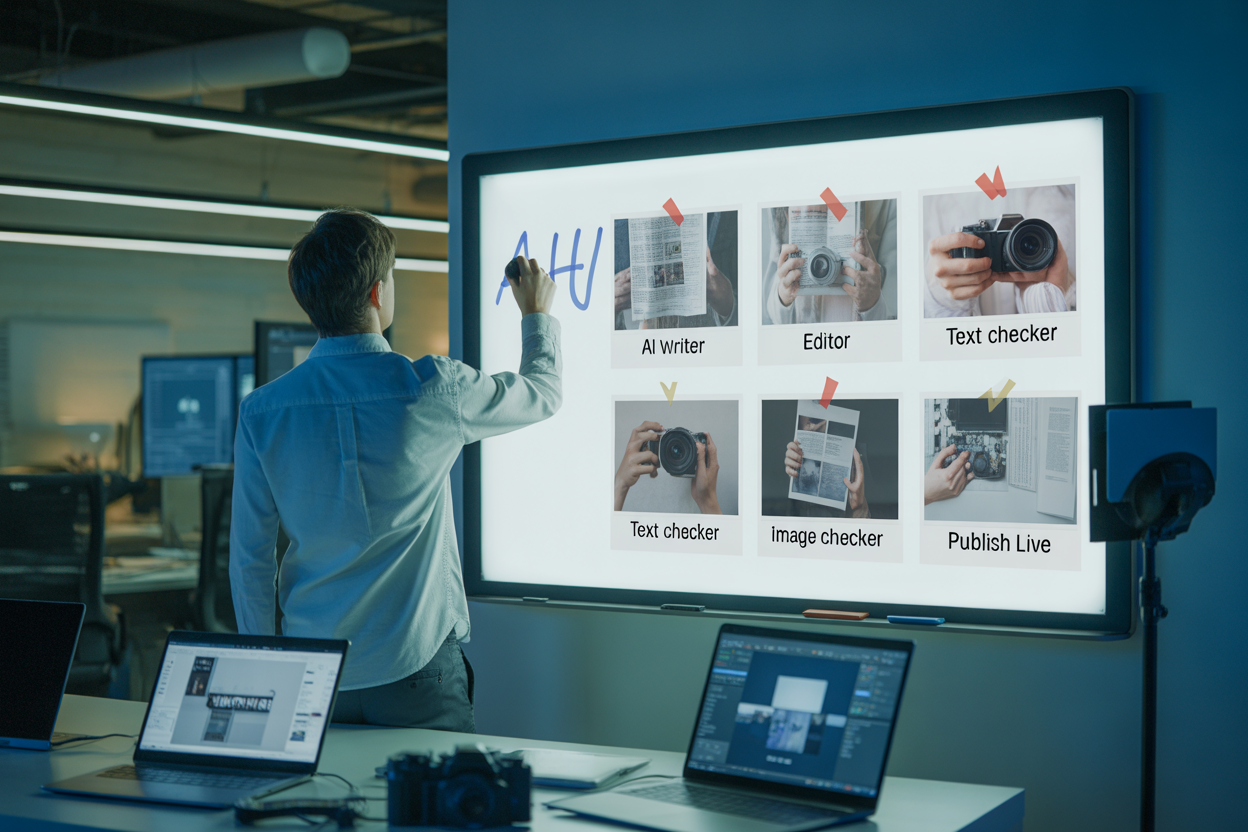
Look, having a powerful tool is one thing, but knowing how to weave it into your daily operations is what really gets you results. An ai checker shouldn't be an afterthought; it should be a deliberate step in your content creation process. How you use it is going to change depending on your business. If you're an entrepreneur running the whole show yourself, your process might be as simple as using a free tool like ZeroGPT for one last check on a blog post before you hit publish. That quick check helps make sure your personal brand voice stays legit and you don't accidentally come off sounding like a robot, which could turn off your audience. For marketing agencies, the approach really has to be more built-in and systematic.
You can integrate a tool like Copyleaks with its API access directly into your project management system and create an automatic quality checkpoint. You could even set a rule that no content gets sent to a client for review until it scores below a certain AI probability mark. On top of that, using a tool like Originality AI becomes a must for checking content from a wide range of freelance writers. It helps you make sure their work is truly original and not just a slightly polished-up GPT-4 output, which protects both your agency's reputation and your client's SEO. It's all about building a quality assurance system that can scale.
Let's think about specific industries. In the health world, where E-E-A-T is everything, a super-accurate tool like Detecting-ai.com or GPTZero is non-negotiable. Every claim has to be checked, and the content needs to ooze human expertise. An ai check gives you that final layer of certainty. For an e-commerce business, running product descriptions through a checker like Sapling can help you spot which ones sound a little too cookie-cutter. Real estate and consulting firms can use these tools to ensure their thought leadership articles and market analyses reflect genuine insight, solidifying their status as trusted experts in their field.
The RobotSpeed Approach: Balancing AI Automation with Authenticity
Speaking of workflow, we at RobotSpeed live and breathe this balance every single day. Our entire platform is built on the principle of intelligent AI automation. We provide a service that generates 30 SEO-optimized articles a month and provides daily backlink credits, all designed to dramatically accelerate your content marketing and SEO results. We are unapologetically pro-AI, because we have seen firsthand how it can empower businesses to compete at a scale they never thought possible. But we also know that with great power comes great responsibility. The whole point of AI should be to give humans a boost, not to completely replace our judgment and unique voice.
Our whole philosophy is that AI is the perfect tool for getting a high-quality first draft done. It can take on the heavy lifting of research, structuring, and the initial writing, which can save you hundreds of hours. But the real magic? That happens in the final 20%. We're big believers in a human-in-the-loop process, where the content our platform generates is the ideal starting point for your team to then polish, personalize, and inject with your company's unique voice and experience. This approach gives you the best of both worlds: the incredible speed and efficiency of AI automation mixed with the authenticity and nuance that only a human can bring. It's about scaling your output without sacrificing the quality that builds lasting trust with your audience.
This is why the tools we've discussed today are so important. Using a top-tier ai checker is a perfect complement to a service like RobotSpeed. You can leverage our platform to automate the bulk of your content creation workload, then use an ai checker as part of your final review process. It's a critical step in any modern, smart SEO strategy, making sure every single piece of content you publish is not only optimized for search engines but also guaranteed to meet your high standards for quality and originality. It turns AI from something that could be a risk into a powerful, reliable engine for your growth.
Navigating the Future of Content with Confidence
The rise of generative AI has completely and forever changed the game in digital marketing. It's a shift that's just as big as when social media or mobile browsing first came on the scene. Trying to fight this change is pointless; the secret is to adapt and use it wisely. A lot of the fear around AI content really comes from a feeling of not having control or transparency. Putting a reliable ai checker into your workflow is the single best thing you can do to get that control back. It pulls back the curtain on the unknown, letting you make smart decisions about the content you're creating and putting out into the world. It acts as your quality control mechanism, your brand reputation guardian, and your SEO insurance policy all in one.
The tools we've explored, from the hyper-accurate Detecting-ai.com V2 to the seamlessly integrated Copyleaks, offer a range of solutions for every type of business. Whether you are a solo entrepreneur needing a quick verification or a global enterprise building an automated content pipeline, there is a tool that fits your needs. As AI models keep getting better, so will these detection tools. Keeping yourself informed and having the right tools on hand will be an ongoing job, but it's one that's absolutely essential for anyone who's serious about succeeding long-term in the digital world. An ai checker isn't an optional accessory anymore; it's a core piece of a strong and effective content strategy for 2026 and beyond. Are you ready to tap into the power of AI automation while keeping total control over your content's quality?
The future of SEO isn't about picking between AI and human creativity, it's about blending them together perfectly. Let RobotSpeed take care of the heavy lifting of content creation and backlink outreach so you can focus on what really matters: sharpening your message and growing your business.
Explore RobotSpeed's services today and take the first step towards smarter, scalable SEO.
FAQ - Frequently Asked Questions
Can AI detectors identify content from specific AI models like GPT-4 or Claude?
Not reliably. Most tools don't distinguish between GPT-4, Claude, or Gemini because they analyze patterns rather than signatures.
They spot statistical quirks common to all language models. A few enterprise platforms claim model-specific detection, but accuracy remains disputed in independent tests.
The real insight? Detection focuses on whether content feels machine-generated, not which machine generated it. That distinction matters less than you'd think for practical use.
What is the difference between AI detection and plagiarism detection?
Completely different beasts. Plagiarism tools compare your text against existing content across the web and academic databases, hunting for copied passages.
AI detection examines writing patterns instead. It looks for telltale statistical fingerprints that suggest machine authorship, even when the content is original. You could write something entirely unique with AI and pass plagiarism checks while failing AI detection.
Some platforms now bundle both features, but they operate independently. Clean plagiarism results don't guarantee clean AI detection scores.
How accurate are free AI detection tools compared to paid ones?
Free versions typically hit 70-80% accuracy on straightforward cases. Not terrible, but unreliable for decisions that matter.
Paid tools push 85-92% through better training data and more sophisticated algorithms. The gap widens dramatically with edited content or non-English text, where free options often produce random results. We've tested dozens, and premium versions consistently catch nuanced cases that free checkers miss.
Do AI detectors work on content that has been edited by humans?
Yes, but performance drops sharply. Light edits like fixing grammar or swapping a few words barely fool modern detectors.
Substantial rewrites that change sentence structure, vary rhythm, and inject personal voice create real confusion for these tools. Detection rates plummet from 90% to roughly 60% once humans rework multiple paragraphs thoughtfully.
Hybrid content poses the biggest challenge. When human writing blends with AI assistance, scores become unreliable. The detector might flag your original introduction simply because it sits next to AI-generated body text.
And here's the kicker: false positives spike with edited content. Perfectly human paragraphs sometimes get flagged after minimal AI touch-ups, especially in academic or formal contexts where vocabulary naturally overlaps with model training data.